

Home
Class 11
PHYSICS
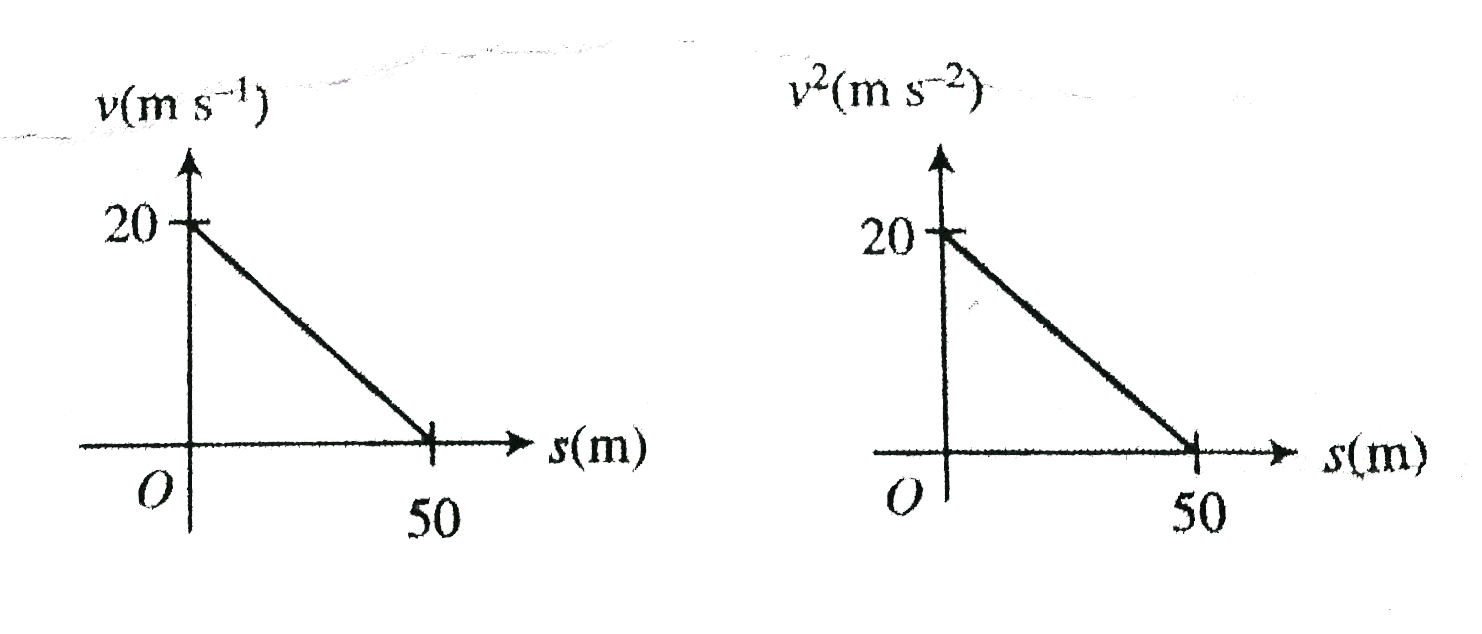
The v-s and v^(2)-s graph are given for ...

The `v-s` and `v^(2)-s` graph are given for two particles. Find the accelerations of the particles at `s=0`.
.

Promotional Banner

Similar Questions

Explore conceptually related problems

If velocity of a particle is given by v=2t^(2)-2 then find the acceleration of particle at t = 2 s.

If velcotiy of a particle is given by v=2t-1 then find the acceleration of particle at t = 2s.

A particle moves in a circle of radius 1.0 cm at a speed given by v = 2.0 t, where v is in cm cdot s^(-1) and t in seconds. Find the radial acceleration of the particle at t = 1 s.

A particle moves in a circle of radius 1.0cm with a speed given by v=2t , where v is in cm//s and t in seconds. (a) Find the radial acceleration of the particle at t=1s . (b) Find the tangential acceleration of the particle at t=1s . (c) Find the magnitude of net acceleration of the particle at t=1s .

A particle moves in a circular path such that its speed 1v varies with distance s as v = sqrt(s) , where prop is a positive constant. Find the acceleration of the particle after traversing a distance s .

A particle moves in a circular path such that its speed 1v varies with distance s as v = sqrt(s) , where prop is a positive constant. Find the acceleration of the particle after traversing a distance s .

A particle moves in a circular path such that its speed v varies with distance as V= alphasqrt(s) where alpha is a positive constant. Find the acceleration of the particle after traversing a distance s.

A particle moves in a circular path such that its speed v varies with distance as V= alphasqrt(s) where alpha is a positive constant. Find the acceleration of the particle after traversing a distance s.

A particle moves in circle of radius 1.0 cm at a speed given by v=2.0 t where v is in cm/s and t in seconeds. A. find the radia accelerationof the particle at t=1 s. b. Findthe tangential acceleration at t=1s. c.Find the magnitude of the aceleration at t=1s.