Home
Class 12
MATHS
Consider the cube in the first octant wi...

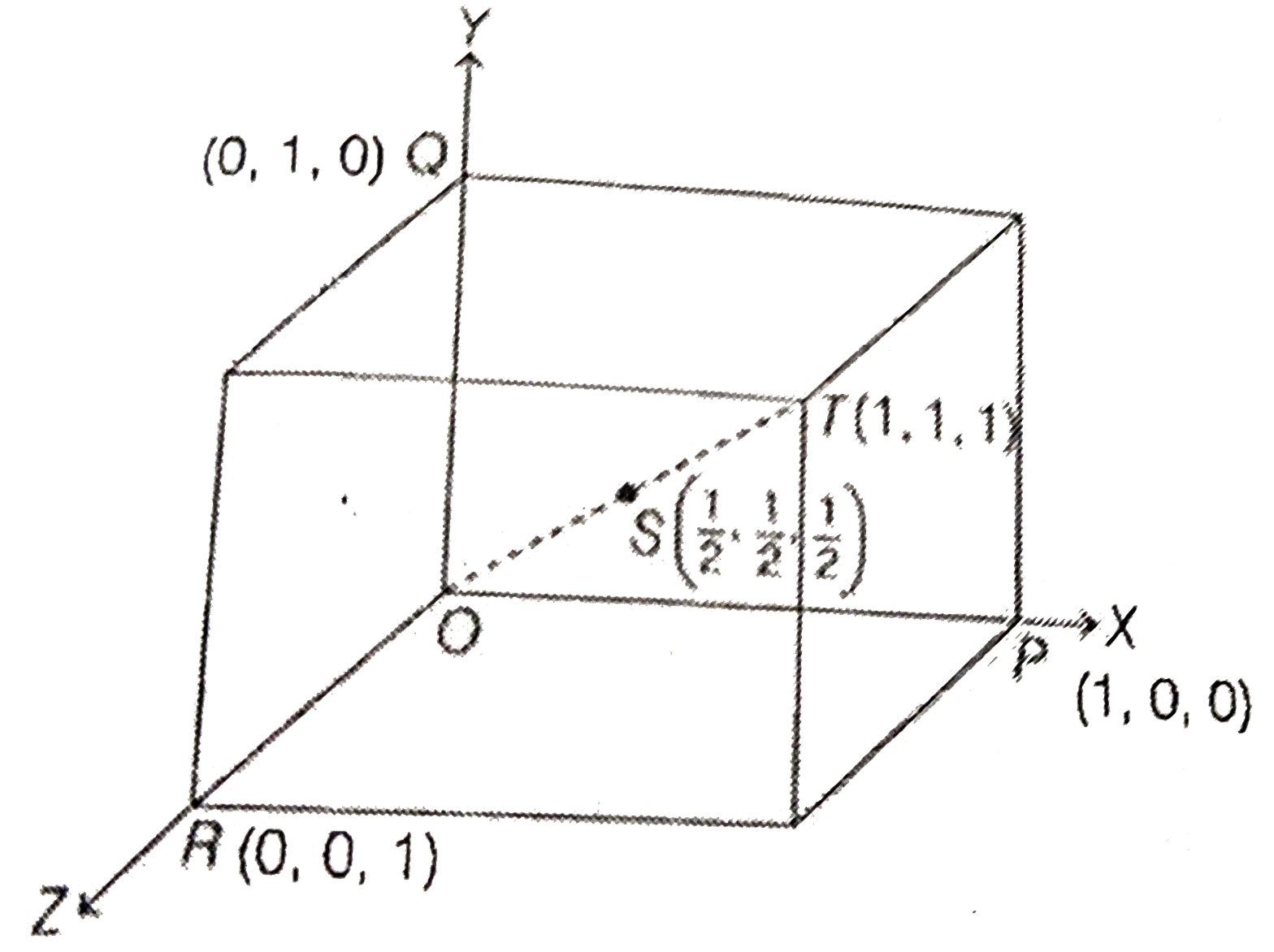
Consider the cube in the first octant with sides OP,OQ and OR of length 1, along the x-axis, y-axis and z-axis, respectively, where `O(0,0,0)` is the origin. Let `S(1/2,1/2,1/2)` be the centre of the cube and T be the vertex of the cube opposite to the origin O such that S lies on the diagonal OT. If `vec(p)=vec(SP), vec(q)=vec(SQ), vec(r)=vec(SR)` and `vec(t)=vec(ST)` then the value of `|(vec(p)xxvec(q))xx(vec(r)xx(vec(t))| is `

Text Solution

Verified by Experts

The correct Answer is:
`(0.5)`

(0.5) Here P(1,0,0) Q(0,1,0) R (0,0,1) , T =(1,1,1) and
`S= ((1)/(2) ,(1)/(2),(1)/(2))`

Now ` vec(P) = vec(SP) =vec(OP) - vec(OS)`
`= ((1)/(2) hat(i) -(1)/(2) hat(j) -(1)/(2) hat(k)) = (1)/(2) (hat(i) - hat(j) - hat(k))`
` vec(q) = vec(SQ) = (1)/(2) (hat(i) + hat(j) - hat(k))`
`vec(r ) = vec(SR) = (1)/(2) (-hat(i) - hat(j) + hat(k))`
And `vec(t) = vec(ST) = (1)/(2) (hat(i) + hat(j) + hat(k))`
`vec(p) xx vec(q) = (1)/(4) |{:(hat(i) ,,hat(j) ,,hat(k) ),(1,,-1,,-1),(-1,,1,,-1):}| =(1)/(4) (2hat(i) + 2hat(j))`
` and vec(r ) xx vec(t ) = (1)/(4) |{:(hat(i) ,,hat(j) ,,hat(k)),(-1,,-1,,1),(1,,1,,1):}| =(1)/(4) (-2hat(i) + 2hat(j))`
Now `(vec(p) xx vec(q)) xx (vec(r ) xx vec(t)) = (1)/(16) |{:(hat(i) ,,hat(j),,hat(k) ),(2,,2,,2),(-2,,2,,0):}|`
`=(1)/(16) (8hat(k)) = (1)/(2) hat(k)`
`:. (p xx q) xx (vec(r ) xx vec(t)) = |(1)/(2) hat(k)|= (1)/(2) = 0.5`
Promotional Banner

Similar Questions

Explore conceptually related problems

If vec a=vec p+vec q,vec p xxvec b=0 and vec q*vec b=0 then prove that (vec b xx(vec a xxvec b))/(vec b*vec b)=vec q

Let vec(p),vec(q),vec(r) be three unit vectors such that vec(p)xxvec(q)=vec(r) . If vec(a) is any vector such that [vec(a)vec(q)vec(r )]=1,[vec(a)vec(r)vec(p )]=2 , and [vec(a)vec(p)vec(q )]=3 , then vec(a)=

OX, OY and OZ are three edges of a cube andn P,Q,R are the vertices of rectangle OXPY, OXQZ and OYSZ respectively. If vec(OX)=vecalpha, vec(OY)=vecbeta and vec(OZ)=vecgamma express vec(OP), vec(OQ), vec(OR) and vec(OS) in erms of vecalpha, vecbeta and vecgamma.

Let O be the origin nad P, Q, R be the points such that vec(PO)+vec(OQ)=vec(QO)+vec(OR) . Then which one of the following is correct?

P(vec p) and Q(vec q) are the position vectors of two fixed points and R(vec r) is the position vectorvariable point.If R moves such that (vec r-vec p)xx(vec r-vec q)=0 then the locus of R is

vec OA=vec a,vec OB=10vec a+2vec b, and vec OC=b where O is origin.Let p denote the area of th quadrilateral OABC and q denote the area of teh parallelogram with OA and OC as adjacent sides.Prove that p=6q.

Three vectors vec(P) , vec(Q) and vec( R) are such that |vec(P)| , |vec(Q )|, |vec(R )| = sqrt(2) |vec(P)| and vec(P) + vec(Q) + vec(R ) = 0 . The angle between vec(P) and vec(Q) , vec(Q) and vec(R ) and vec(P) and vec(R ) are

