

Home
Class 10
MATHS
With vertices A, B and C of a triangle A...

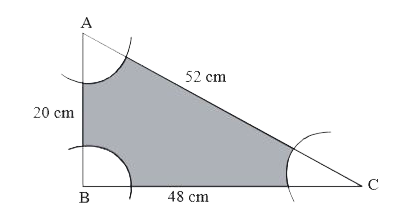
With vertices A, B and C of a triangle ABC as centres, arcs are drawn with radius 6 cm each in fig. If AB= 20 cm, BC= 48 cm and CA= 52 cm, then find the area of the shaded region.

Promotional Banner

Similar Questions

Explore conceptually related problems

With the vertices A,B and C of a triangle ABC as centres, arcs are drawn with radii 5 cm each as shown in the given figure. If AB=14cm, BC=48cm and CA=50cm then find the area of the shaded region. [Use pi=3.14 ]

A triangle ABC is drawn to circumscribe a circle. If AB = 13 cm, BC = 14 cm and AE =7 cm, then find AC.

In figure, arcs have been drawn of radius 21 cm each with vertices A , B , C and D of quadrilateral ABCD as centres . Find the area of the shaded region.

In figure, arcs have been drawn of radius 21cm each with vertices A,B,C and D of quadrilateral ABCD as centres . Find the area of the shaded region.

The area of an equilateral triangle ABC is 17320.5 cm^2 . With each vertex of the trianlge as centre, a circle is drawn with radius equal to half the length of the side of the triangle. Find the area of the shaded region .

Construct Delta ABC with AB = 4.5 cm, BC = 7 cm and CA = 6 cm.

ABC is a triangle is which AB = 6 cm, BC = 8 cm and CA = 10 cm. What is the value of cot(A/4) ?

ABC is a triangle in which AB = 6cm, BC = 8 cm and CA = 10 cm. What is the value of cot (A/4)?

Construct a triangle ABC given that : AB = 5 cm, BC = 4 cm and CA = 6 cm

If arcs of radius r cm are drawn with the vertices of an equilateral triangle ABC as shown in the figure, then the area of the shaded region is