Home
Class 12
PHYSICS
The position of a particle moving along ...

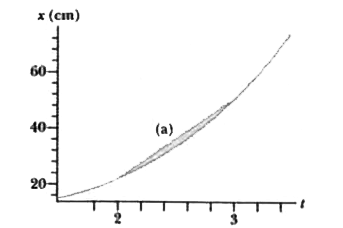
The position of a particle moving along the x axis is given in centimeters by `x = 9.75 + 1.50 t^(3)`, where t is in seconds. Calculate (a) the average velocity during the time interval `t = 2.00s ` to `t= 3.00s`, (b) the instantaneous velocity at `t = 2.00 s` , (c) the instantaneous velocity at `t = 3.00s`, (d) the instantaneous velocity at `t= 2.50s`, and (e) the instantaneous velocity when the particle is midway between its positions at `t=2.00s` and `t=3.00s` . (f) Graph `x` versus t and indicate your answers graphically

Text Solution

Verified by Experts

KEY IDEA
We use Eq. 2-2 for average velocity and Eq. 2-4 for instantaneous velocity, and work with distances in centimeters and times in seconds.
Calculations : (a) We plug into the given equation for `x` for `t=2.00s` and `t=3.00s` and obtain `x_(2)=21.75cm` and `x_(3) = 50.25cm`, respectively. The average velocity during the time interval `2.00 le t le 3.00s ` is
`v_("avg") = (Delta x)/(Delta t) = (50.25cm - 21.75cm)/(3.00s - 2.00s)`
which yields `v_("avg")=28.5 cm//s`.
(b) The instantaneous velocity is `v = (dx)/(dt) = 4.5 t^(2)`, which, at time `t=2.00s`, yields `v=(4.5)(2.00)^(2) =18.0cm//s`.
(c) At `t=3.00s`, the instantaneous velocity is
`v = (4.5)(3.00)^(2) =40.5cm//s`.
(d) At `t=2.50s`, the instantaneous velocity is
`v= (4.5)(2.50)^(2) = 28.1 cm//s`.
(e) Let `t_(m)` stand for the moment when the particle is midway between `x_(2)` and `x_(3)` ( that is, when the particle is at `x_(m)= (x_(2)+x_(3))//2=36cm`). Therefore,
`x_(m)= 9.75 + 1.5 t_(m)^(3) rArr t_(m) = 2.596`
in seconds. Thus, the instantaneous speed at this time is `v= 4.5(2.596)^(2) =30.3 cm//s`.
(f) The answer to part (a) is given by the slope of the straight line between `t=2` and `t=3` in this x-vs-t plot. The answers to parts (b), (c), (d), and (e) correspond to the slopes of tangent lines ( not shown but easily imagined ) to the curve at the appropriate points.
Promotional Banner

Topper's Solved these Questions

  • MOTION ALONG A STRAIGHT LINE

    RESNICK AND HALLIDAY|Exercise SAMPLE PROBLEM 2.04|2 Videos
  • MOTION ALONG A STRAIGHT LINE

    RESNICK AND HALLIDAY|Exercise SAMPLE PROBLEM 2.02|2 Videos
  • MOTION ALONG A STRAIGHT LINE

    RESNICK AND HALLIDAY|Exercise PRACTICE QUESTIONS ( Integer Type )|3 Videos
  • MAGNETIC FORCE

    RESNICK AND HALLIDAY|Exercise Practice Questions (Integer type )|7 Videos
  • MOTION IN TWO AND THREE DIMENSIONS

    RESNICK AND HALLIDAY|Exercise PRACTICE QUESTIONS (MATRIX-MATCH)|10 Videos

Similar Questions

Explore conceptually related problems

The position of the particle moving along x-axis is given by x=2t-3t^(2)+t^(3) where x is in mt and t is in second.The velocity of the particle at t=2sec is

The displacement of a particle moving along an x axis is given by x=18t+5.0t^(2) , where x is in meters and t is in seconds. Calculate (a) the instantaneous velocity at t=2.0s and (b) the average velocity between t=2.0s and t=3.0s .

The position (in meters) of a particle moving on the x-axis is given by: x=2+9t +3t^(2) -t^(3) , where t is time in seconds . The distance travelled by the particle between t= 1s and t= 4s is m.

The intantaneous coordinates of a particle are x= (8t-1)m and y=(4t^(2))m . Calculate (i) the average velocity of the particle during time interval from t =2s to t=4s (ii) the instantaneous velocity of the particle at t = 2s .

A particle is moving in a straight line. Its displacement at any instant t is given by x = 10 t+ 15 t^(3) , where x is in meters and t is in seconds. Find (i) the average acceleration in the intervasl t = 0 to t = 2s and (ii) instantaneous acceleration at t = 2 s.

The position of a particle moving along the straight line is given as s= (t^(2)-4t+3)m where t is time in s .The magnitude of displacement of the particle during time interval t=0 to till its velocity becomes zero

The position of an object moving along x-axis is given by a+bt^(2) , where a=8.5 m and b= 2.5m//s^(2) and t is measured in seconds. The average velocity (in m/s) of the object between t=2s and t=4s is

A particle is moving along the x-axis such that s=6t-t^(2) , where s in meters and t is in second. Find the displacement and distance traveled by the particle during time interval t=0 to t=5 s .

A particle is moving along the x-axis. Consider it’s a-t graph. If initial velocity is 10 m//s, sketch the v-t graph and calculate the displacement in the time interval t=0 to 12 s.

A particle Moves along x axis satisfying the equation x=[t(t+1)t-2 where t is in seconds and x is in Meters Then the Magnitude of initial velocity of the particle in M/s is

