Home
Class 12
PHYSICS
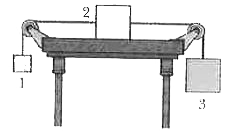
When the three blocks in Fig. 6-45 are r...

When the three blocks in Fig. 6-45 are released from rest, they accelerate with a magnitude of 0.500 m/s2 Block 1 has mass M, block 2 has 2M, and block 3 has 2M. What is the coefficient of kinetic friction between block 2 and the table?

Text Solution

Verified by Experts

`mu_(k)=0.37`
Promotional Banner

Topper's Solved these Questions

  • FORCE AND MOTION-II

    RESNICK AND HALLIDAY|Exercise PRACTICE QUESTIONS (Single Correct Choice Type)|23 Videos
  • FORCE AND MOTION-II

    RESNICK AND HALLIDAY|Exercise PRACTICE QUESTIONS (More than One Correct Choice Type)|4 Videos
  • FORCE AND MOTION-II

    RESNICK AND HALLIDAY|Exercise CHECKPOINTS|5 Videos
  • FORCE AND MOTION - I

    RESNICK AND HALLIDAY|Exercise PRACTICE QUESTIONS (Integer Type)|3 Videos
  • GAUSS' LAW

    RESNICK AND HALLIDAY|Exercise PRACTICE QUESTIONS (INTEGER TYPE)|3 Videos

Similar Questions

Explore conceptually related problems

When the three blocks of masses M, 2M and 2M in the system are released from rest, they accelerate with a magnitude of 1 m/ s^(2) . What is the coefficient of kinetic friction between block on the table and the table top? (neglect the force of friction in the pulleys and take g =10 m/ s^(2) )

Determine the acceleration of the 5 kg block A . Neglect the mass of the pulley and cords . The block B has a mass of 10 kg , The coefficient of kinetic friction between block B and the surface is mu _(k) = 0.1 (take g = 10 m//s^(2))

The three blocks in figure-2.25 are released from rest and accelerate at the rate of 5m//s^(2) . If M = 4kg, what is the magnitude of the frictional force on the block that slides horizontally? [140 N]

A block with mass 0.50 kg is forced against a horizontal spring of negligible mass , compressing the spring a distance of 0.20 m (figure). When released, the block moves on a horizontal table top for 1.00N//m . What is the coefficient of kinetic friction mu _(k) , between the block and the block and the table?

A 4.00g bullet travelling horizontally with a velocity of magnitude 500m//s is fired into a wooden block with a mass of 1.00kg , initially at rest on a level surface. The bullet passes through the block and emerges with speed 100m//s . The block slides a distance of 0.30m along the surface from its initial position. (a) What is the coefficient of kinetic friction between block and surface? (b) What is the decrease in kinetic energy of the bullet? (c) What is the kinetic energy of the block at the instant after the bullet has passed through it? Neglect friction during collision of bullet with the block.

Block A has a mass 3kg and is sliding on a rough horizontal surface with a velocity u_A=2m//s when it makes a direct collision with block B, which has a mass of 2kg and is originally at rest. The collision is perfectly elastic. Determine the velocity of each block just after collision and the distance between the blocks when they stop sliding. The coefficient of kinetic friction between the blocks and the plane is mu_k=0.3 ( Take g=10m//s^2 )

A block B is placed over a cart which in turn lies over a smooth horizontal floor. Block A and Block C are connected to block B with light inextensible strings passing over light frictionless pulleys fixed to the cart as shown. Initially the blocks and the cart are at rest. All the three blocks have mass m and the cart has mass M(M=3m) . Now a constant horizontal force of magnitude F is applied to block A towards right. Q. Let the coefficient of friction between block B and cart is mu(mugt0) and friction is absent everywhere else. Then the maximum value of force F applied to block A such that there is no relative acceleration between block B and cart is

RESNICK AND HALLIDAY-FORCE AND MOTION-II-PROBLEMS
  1. A small block of mass m is projected on a larger block of mass 10 m an...

    Text Solution

    |

  2. In Fig. 6-29, a force vecP acts on a block weighing 45 N. The block is...

    Text Solution

    |

  3. You testify as an expert witness in a case involving an accident in wh...

    Text Solution

    |

  4. A 12 N horizontal force vecF pushes a block weighing 5.0 N against a v...

    Text Solution

    |

  5. In Fig. 6-42, a box of Cheerios (mass m(c)= 1.0 kg) and a box of Wheat...

    Text Solution

    |

  6. In Fig. 6-43, a 15 kg sled is attached to a 2.0 kg sand box by a strin...

    Text Solution

    |

  7. In Fig. 6-44a, a sled is held on an inclined plane by a cord pulling d...

    Text Solution

    |

  8. When the three blocks in Fig. 6-45 are released from rest, they accele...

    Text Solution

    |

  9. A 4.10 kg block is pushed along a floor by a constant applied force th...

    Text Solution

    |

  10. Figure 6-47 shows three crates being pushed over a concrete floor by a...

    Text Solution

    |

  11. In Fig. 6-48, a 2.0 kg block lies on a 20 kg trolley that can roll acr...

    Text Solution

    |

  12. In Fig. 6-49, two blocks are connected over a pulley. The mass of blo...

    Text Solution

    |

  13. In Fig. 6-50, block A of mass 2.0 kg, block B of 3.0kg, and block Cof ...

    Text Solution

    |

  14. A toy chest and its contents have a combined weight of 200 N. The coef...

    Text Solution

    |

  15. In Fig. 6-52, two blocks, in contact, slide down an inclined plane AC ...

    Text Solution

    |

  16. A block is pushed across a floor by a constant force that is applied a...

    Text Solution

    |

  17. In Fig. 6-54, a slab of mass m(1) = 40 kg rests on a frictionless floo...

    Text Solution

    |

  18. A water droplet 4.0 mm in diameter is falling with a speed of 10 km/h ...

    Text Solution

    |

  19. Continuation of Problem z Now assume that Eq, 6-29 gives the magnitude...

    Text Solution

    |

  20. Assume Eq. 6-29 gives the drag force on a pilot plus ejec-tion seat ju...

    Text Solution

    |
