(1) Because we have particles, the magnitude of the gravitational force on particel 1 due to either of the other particle is given by Eq. 13-1 `(F = Gm_1 m_2//r^2)`. (2) The direaction of either gravitational force on particle 1 is toward the particle responsible for it. (3) Because the forces are not along a single axis, we connot simply add or subtract their magnitudes or their components to get the net force. Instead,we must add them as vectors.
Calculations : From Eq. 13-1, the magnitude of the force `vecF_12` on particle 1 from particle 2 is
`F_12 = (Gm_1 m_2)/a^2`
`=((6.67 xx 10^(-11)m^3//Kg. s^2)(6.0 kg)(4.0 Kg))/((0.020 m)^2)`
`4.00 xx 10^(-6)N`. (13-7)
Similartly, the magnitude of force `vec F_(13)` on particle 1 form particel 3 is
`F_(13) = (Gm_1m_3)/((2a)^2)`
`=((6.67 xx 10^(-11)m^3//Kg.s^2)(6.0kg)(4.0kg))/((0.040m)^2)`
`=1.00xx10^(-6)N`. (13-8)
Force `vecF_(12)` is directed in the positive direactionof the y axis (fig. 13-4b) and has only the y component `F_12`. Similarly, `vecF_(13)` is direacted in the negative direaction of the x axis and has only the x component : We draw the force diagrams with the tail of a force vector anchored on the particel experiencing the force. Drawing them in other ways invites errors, especially on exams.)
To find the net force `vecF_("1,net")` on particle 1, we must add the two forces as vectors (figs 13-4d and e). We can do so no a vector-calculator. However, here we notes as vector -capable calculator. However, here we note that `-F_13 and F_12` are actually the x and y components of `vecF_("1.net")`. Therefore, we can use Eq. 3-6 to find first the magnitude and then the direaction of `vecF_("1.net")`. The magnitude is
`F_("1.net") = sqrt((F_12)^2 +(-F_13)^2)`
`=sqrt((4.00xx10^(-6)N)^2+(-1.00xx10^(-6)N)^2)`
`=4.1xx10^(-6)N`.
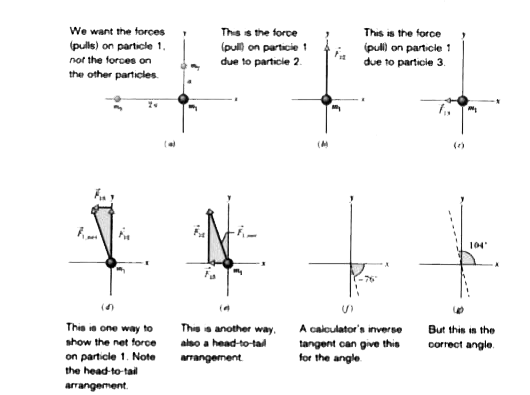
Figure 13-4 (a) An arrangement of three particle. The force on particle 1 due to (b) particel 2 and ( c) particle 3.(d)-(g) Ways to combine the forces to get the net force magnitude and orientation. In Wiley PLUS, this figure is avaliable as an animation with voiceover.
Relative to the positive direction of the x axis, Eq. 3-6 gives the direactionof `vecF_("1.net")` as
`theta= tan^(-1)""(F_(12))/(-F_13)=tan^(-1)""(4.00xx10^(-6)N)/(-1.00xx10^(-6)N) = -76^@`.
Is this a reasonable direaction (Fig.13-4F) ? No, because the direaction of `vecF_("1.net")` must be between the dreaction of `vecF_12 and vecF_(13)`. Recall from Chapter 2 that a calculator displays only one of the two possible answers to a `tan^(-1)` funeton . We find the other answer by adding `180^@` :
`-76^@ + 180^@ = 104^@`.
which is a reasonable direaction for `vecF_("1.net")` (Fig.13-4g).


