Home
Class 12
PHYSICS
Four paticle of masses m1 = 2 m, m2 = 4 ...

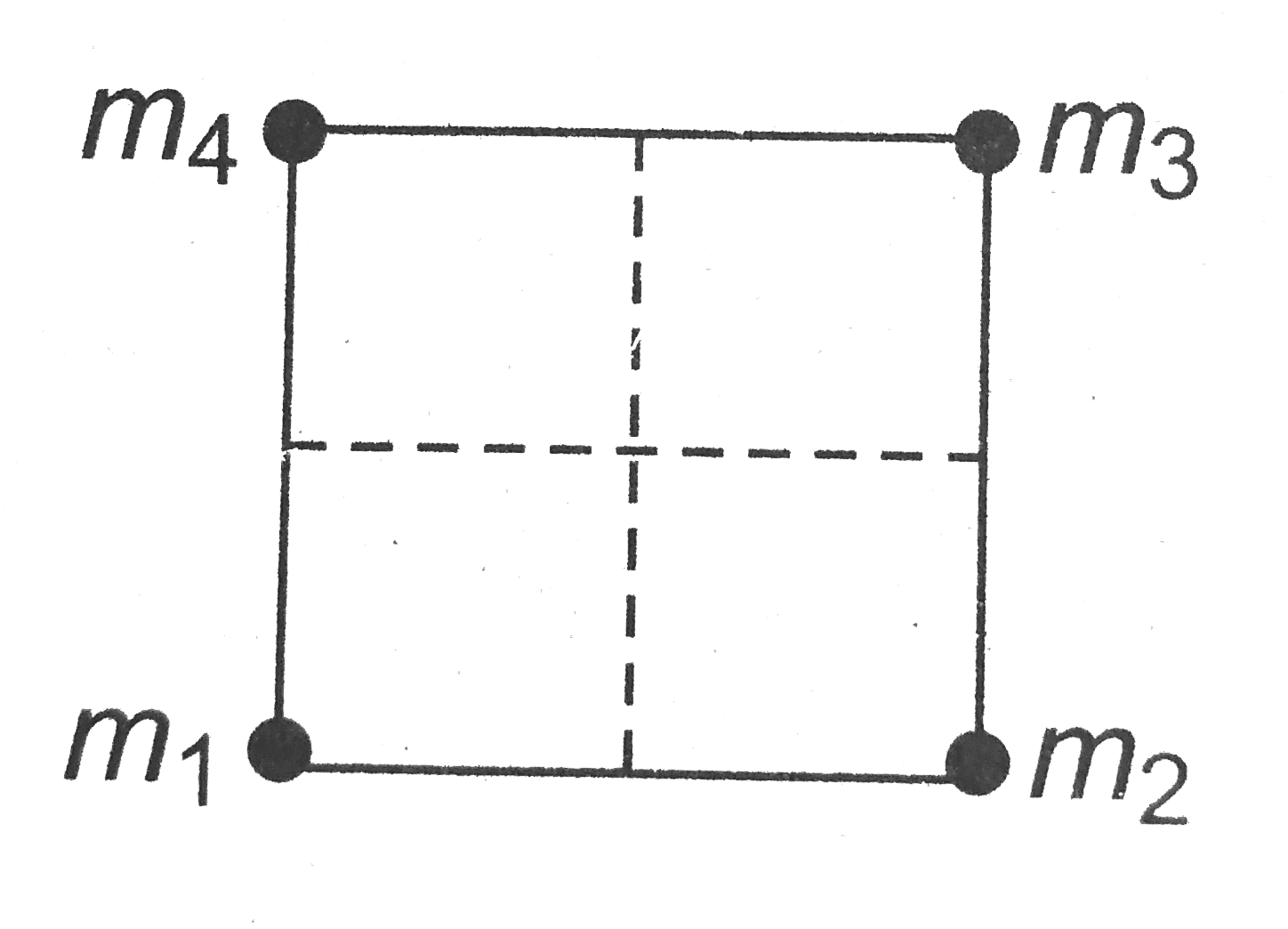
Four paticle of masses `m_1 = 2 m, m_2 = 4 m, m_3 = m and m_4` are placed at four corners of a square. What should be the value of `m_4` so that the centres of mass of all the four particle are exactly at the centre of the square ?

Text Solution

Verified by Experts

Because we have particles, the magnitude of the gravitational force on particel 1 due to either of the other particles is given by Eq. 13-1 (`F = Gm_1m_2//r^2`). The direction of a gravitational force on partile 1 is toward the particle responsible for the force. We can use symmetry to eliminate unneeded calculations.
Calculations : For the magnitudes of the forces on partice 1,first note that particles 2 and 4 have equal masses and equal distance of r = 2a from particle 1. Thus, form Eq. 13-1, we find that
`F_(12) = F_14 =(Gm_1m_3)/((2a)^2) (13-9)`
Similarly, since particles 3 and 5 have equal masses and are both at distance r = a from particle 1, we find
`F_(13) = F_(15) = (Gm_1m_3)/(a^2)` (13-10)
We could now substicute known data into these two equations to evaluate the magnitude of the forces,indicate thedireactionof the fores on the free-body diagram of Fig. 13-5b,and then find the net force either (1) by resolving the vectors into x and y components, finding the net x andnet y components, and then vectorially combining tem or (2) by adding the vectors directly on a vector-capable calculator.
Instead, however, we shall make further use of the symmetry of the problem. First, we note that `vecF_(12) and vecF_(14)` are equal inmagnitude but opposite in direaction, thus, those forces cancel. Inspection of Fig. 13-5b and Eq. 13-10 reveals that the x components of `vecF_(13) and vecF_15` also cancel, and that their y components are identicalin magnitude and both act in the positive direaction of the y axis.
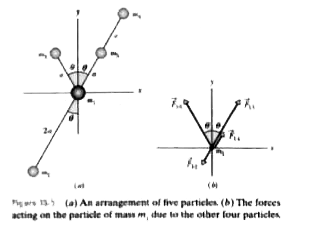
Figure 13-5 (a) An arrangement of five particles. (b) The forces acting on the particle of mass `m_1` due to the other four particles.
Thus, `vecF_("1.net")` acts in that same direction, and its magnitude is twice the y component of `vecF_(13)` :
`F_("1.net") = 2 F_(13) cos theta = 2(Gm_1m_3)/(a^2) costheta`
`=(2(6.67 xx 10^(-11)m^3//Kg.s^2)(8.0kg)(2.0kg))/((0.020m)^2)cos30^@`
`4.6 xx 10^(-6)N`.
Note: The presence of particle 5 along the line between partiicles 1 and 4 does not alter the gravitational force on particel 1 from particle 4.
Promotional Banner

Topper's Solved these Questions

  • GRAVITATION

    RESNICK AND HALLIDAY|Exercise CHECKPOINT|5 Videos
  • GRAVITATION

    RESNICK AND HALLIDAY|Exercise PROBLEMS|63 Videos
  • GEOMETRICAL OPTICS : REFRACTION

    RESNICK AND HALLIDAY|Exercise Practice questions(Integers)|4 Videos
  • HEAT-MEASUREMENT AND TRANSFER

    RESNICK AND HALLIDAY|Exercise PRACTICE QUESTIONS( INTEGER TYPE)|5 Videos

Similar Questions

Explore conceptually related problems

Four particle of masses m_(1)=2kg,m_2=4kg,m_(3)=1kg and m_(4) are placed at four corners of a square as shown in figure. Can mass of m_(4) be adjusted I such a way that the centre of mass of system will be at the centre of the square C.

Four particles of masses m, m, 2m and 2m are placed at the corners of a square of side a, as shown in fig. Locate the centre of mass.

Four particles of masses m, m, 2m and 2m are placed at the four corners of square of side a. Find the centre of mass of the system.

Four particles of masses m,m 2 m and 2m are placed at the four corner of a squre of side "a" as shown in figure -4. 107. The (x,y) coordinates of the centre of mass are:

If four different masses m_1, m_2,m_3 and m_4 are placed at the four corners of a square of side a , the resultant gravitational force on a mass m kept at the centre is

Four particles of masses 1kg , 2kg , 3kg and 4kg are placed at the four vertices A,B,C and D of a square of side 1m . Find square of distance of their centre of mass from A.

Four particles of masses 1 kg, 2 kg, 3 kg, 4 kg are placed at the corners of a square of side 2 m. Find the coordinates of centre of mass.

Four particles A, B, C and D of masses m, 2m, 3m and 4m respectively are placed at corners of a square of side x as shown in Fig. Locate the centre of mass.

Four bodies of masses 2, 3, 5 and 8 kg are placed at the four corners of a square of side 2 m. The position of CM will be -

Four particles having masses, m, wm, 3m, and 4m are placed at the four corners of a square of edge a. Find the gravitational force acting on a particle of mass m placed at the centre.

