

Home
Class 12
PHYSICS
A thin rod of length L and area of cross...

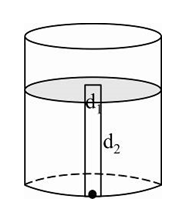
A thin rod of length L and area of cross section S is pivoted at its lowest point P inside a stationary, homogeneous and non-viscous liquid. The rod is free to rotate in a vertical plane about a horizontal axis passing through P. The density `d_(1)`of the rod is smaller than the density `d_(2)` of the liquid. The rod is displaced by a small angle theta from its equilibrium position and then released. Shown that the motion of the rod is simple harmonic and determine its angular frequency in terms of the given parameters ___________ .

Promotional Banner

Similar Questions

Explore conceptually related problems

A uniform metal rod is rotated in horizontal plane about a vertical axis passing through its end at uniform rate. The tension in the rod is

A horizontal rod of mass m and length L is pivoted at one end The rod's other end is supported by a spring of force constant k. The rod is displaced by a small angle theta from its horizontal equilibrium position and released. The angular frequency of the subsequent simple harmonic motion is

A horizontal rod of mass m and length L is pivoted at one end The rod's other end is supported by a spring of force constant k. The rod is displaced by a small angle theta from its horizontal equilibrium position and released. The angular frequency of the subsequent simple harmonic motion is

A uniform rod of length L is free to rotate in a vertical plane about a fixed horizontal axis through B . The rod begins rotating from rest. The angular velocity omega at angle theta is given as

A uniform rod of mass m and length L is free to rotate in the vertical plane about a horizontal axis passing through its end. The rod initially in horizontal position is released. The initial angular acceleration of the rod is:

A horizontal rod of mass m=(3k)/(pi^2) kg and length L is pivoted at one end . The rod at the other end is supported by a spring of force constant k. The rod is displaced by a small angle theta from its horizontal equilibrium position and released . The time period (in second) of the subsequent simple harmonic motion is

A horizontal rod of mass m=(3k)/(pi^2) kg and length L is pivoted at one end . The rod at the other end is supported by a spring of force constant k. The rod is displaced by a small angle theta from its horizontal equilibrium position and released . The time period (in second) of the subsequent simple harmonic motion is