

Home
Class 12
PHYSICS
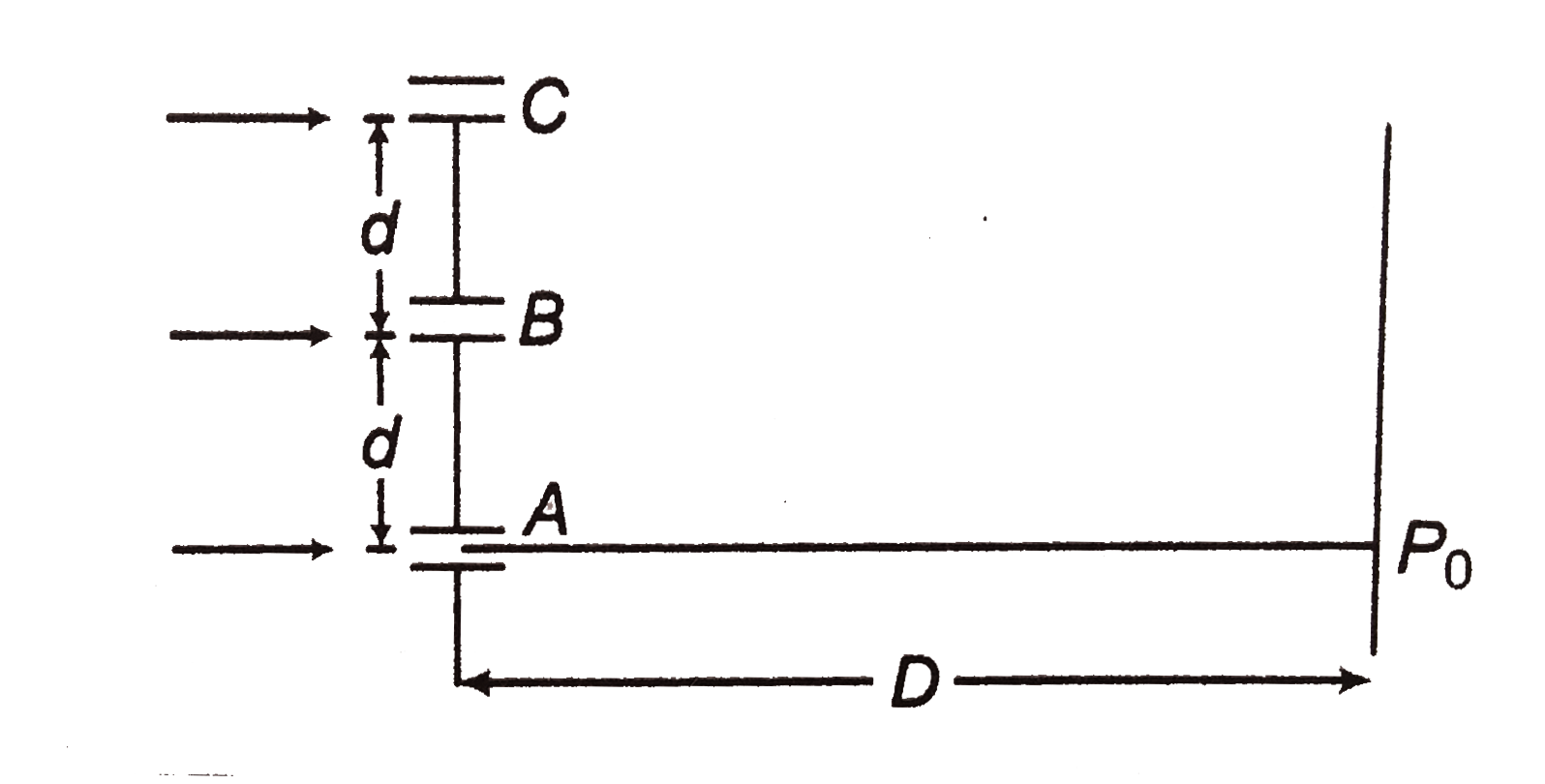
figure shows three equidistant slits ill...

figure shows three equidistant slits illuminated by a monochromatic parallel beam of light. Let `BP_0 -AP_0 = lambda/3` and `Dgtgtlambda`.

(a) Show that d = `sqrt ((2lambdaD)//3)`
(b) Show that the intensity at `P_0` is three times the intensity due to any of the three slits
individually.

Promotional Banner

Similar Questions

Explore conceptually related problems

Three narrow slits A, B and C are illuminated by a parallel beam of light of wavelength lambda , P is a point on the screen exactly in front of point A. Slit plane is at a distance D from the screen (D gtgt lambda) . It is know that "BP – AP ="(1)/(3) (a) Find d in terms of D and lambda (b) Write the phase difference between waves reaching at P from C and A. (c) If intensity of P due to any of the three slits individu- ally is I_(0) , find the resultant intensity at P.

Figure shows a narrow slit S illuminated b a monochromatic light of wavelength lambda in a double-slit experiment. In the path of the rays reaching the upper slit S_(1) , a tube to length L is interposed in which the index of reflection of the medium varies linearly as shown in figure . The position of the central maximum in the interference pattern on the screen was displaceed by N fringes. Find the value of N in terms of mu_(0) , L and lambda .

Figure shows a narrow slit S illuminated b a monochromatic light of wavelength lambda in a double-slit experiment. In the path of the rays reaching the upper slit S_(1) , a tube to length L is interposed in which the index of reflection of the medium varies linearly as shown in figure . The position of the central maximum in the interference pattern on the screen was displaceed by N fringes. Find the value of N in terms of mu_(0) , L and lambda .

A monochromatic light source of wavelength lamda is placed at S. three slits S_(1),S_(2) and S_(3) are equidistant from the source S and the point P on the screen S_(1)P-S_(2)P=lamda//6 and S_(1)P-S_(3)P=2lamda//3 . if I be the intensity at P when only one slit is open the intensity at P when all the three slits are open is-

A monochromatic light source of wavelength lamda is placed at S. three slits S_(1),S_(2) and S_(3) are equidistant from the source S and the point P on the screen S_(1)P-S_(2)P=lamda//6 and S_(1)P-S_(3)P=2lamda//3 . if I be the intensity at P when only one slit is open the intensity at P when all the three slits are open is-

A monochromatic light source of wavelength lamda is placed at S. three slits S_(1),S_(2) and S_(3) are equidistant from the source S and the point P on the screen S_(1)P-S_(2)P=lamda//6 and S_(1)P-S_(3)P=2lamda//3 . if I be the intensity at P when only one slit is open the intensity at P when all the three slits are open is-

Consider the situation shown in figure-6.35. The two slits S_(1) and S_(2) placed symmetrically around the central line are illuminated by a monochromatic light of wavelength lambda . The separation between the slits is d. The light transmitted by the slits falls on a screen E_(1) placed at a distance D from the slits. The slit S_(3) is at the central line and the slit S_(4) is at a distance z from S_(3) . Another screen E_(2) is placed a further distance D away from E_(1) . Find the ratio of the maximum to minimum intensity observed on E_(2) if z is equal is : (a) (lambdaD)/(2d) " "(b) (lambdaD)/(d)" " (c )(lambdaD)/(4d)

A Young's double slit experiment uses a monochromatic light of wavelength lambda . The intensity of each slit is same and is equal to I_(0) . What will be the resultant intensity at a point where waves interfere at a path difference of (lambda)/2 ?

A Young's double slit experiment uses a monochromatic light of wavelength lambda . The intensity of each slit is same and is equal to I_(0) . What will be the resultant intensity at a point where waves interfere at a path difference of (lambda)/2 ?