

Home
Class 12
PHYSICS
One end of the pile of chain falls verti...

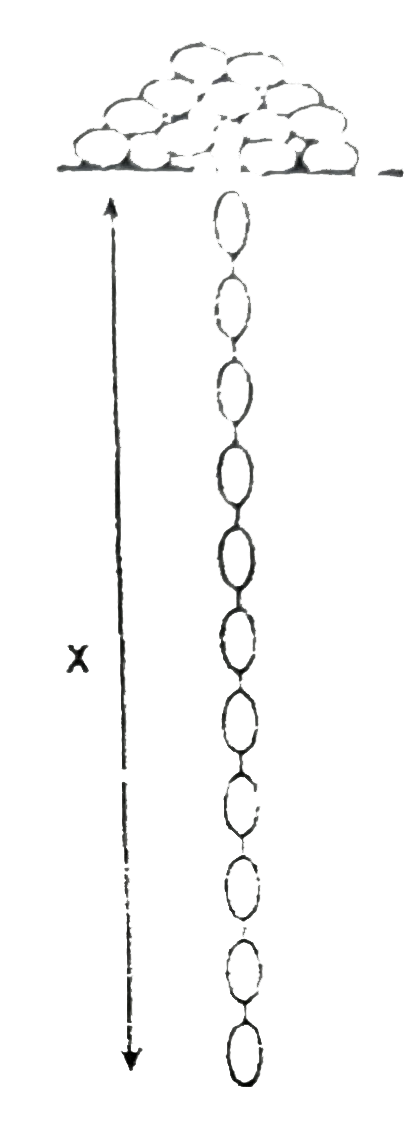
One end of the pile of chain falls vertically through a hole in its support and pull the remaining links steadily. The links which are at rest acquire the velocity of the hanging position suddenly and without loving interaction with the remaining stationery links and with the support. If the acceleration a of the falling chain is `g//k`. Find `k`. Ignore any friction.

Promotional Banner

Similar Questions

Explore conceptually related problems

A very flexible uniform chain of mass M and length l is suspended vertically in a lift so that its lower end is just touching the surface of the floor. When the upper end of the chain is released, it falls with each link coming to rest the instant it strikes the floor of the lift.Find the force exerted by the floor of the lift on the chain at the moment, when one fourth of the chain has already rested on the floor. Assume that lift is moving up with an acceleration g/2.

A chain (A) of length L is coiled up on the edge of a table. Another identical chain (B) is placed straight on the table as shown. A very small length of both the chains is pushed off the edge and it starts falling under gravity. There is no friction (a) Find the acceleration of the chain B at the instant L_(2) length of it is hanging. Assume no kinks in the chain so that the entire chain moves with same speed. (b) For chain A assume that velocity of each element remains zero until it is jerked into motion with a velocity equal to that of the falling section. Find acceleration of the hanging section at the instant a length l_(0) has slipped off the table and its speed is known to be v_(0) at the instant.

A uniform solid cylinder of mass m rests on two horizontal planks. A thread is wound on the cylinder. The hanging end of the thread is pulled vertically down with a constant force F(figure). Find the maximum magnitude of the force F which still does not bring about any sliding of the cylinder, if the coefficient of friction between the cylinder and the planks is equal to k. What is the acceleration w_(max) of the axis of the cylinder rolling down the inclined plane?

A uniform solid cylinder of mass m rests on two horizontal planks. A thread is wound on the cylinder. The hanging end of the thread is pulled vertically down with a constant force F . Find the maximum magnitude of the force F which may be applied without bringing about any sliding of the cylinder, if the coefficient of friction between the plank and the cylinder is equal to mu . What is the maximum acceleration of the centre of mass over the planks?

A uniform solid cylinder of mass m rests on two horizontal planks. A thread is wound on the cylinder. The hanging end of the thread is pulled vertically down with a constant force F . Find the maximum magnitude of the force F which may be applied without bringing about any sliding of the cylinder, if the coefficient of friction between the plank and the cylinder is equal to mu . What is the maximum acceleration of the centre of mass over the planks?

A chain of length L is supported at one end and is hanging vertically when it is released. All of the chain falls freely with acceleration g. The moment, the chain is released a ball is projected up with speed u from a point 2 L below the point of support. Find the interval of time in which the ball will cross through the entire chain.