

Home
Class 12
PHYSICS
The capacitor C1 in the figure shown ini...

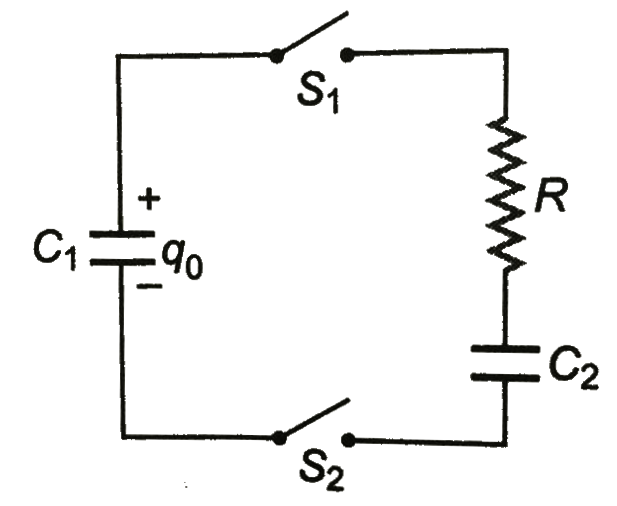
The capacitor `C_1` in the figure shown initially carries a charge `q_0`. When the switches `S_1` and `S_2` are closed,capacitor `C_1` is connected in series to a resistor `R` and a second capacitor `C_2` which is initially uncharged.

The flown through wires as a function of time is
where `C=(C_1C_2)/(C_1+C_2)`

Promotional Banner

Similar Questions

Explore conceptually related problems

The capacitor C_1 in the figure shown initially carries a charge q_0 . When the switches S_1 and S_2 are closed,capacitor C_1 is connected in series to a resistor R and a second capacitor C_2 which is initially uncharged. The charge flown through wires as a function of time is where C=(C_1C_2)/(C_1+C_2)

The capacitor C_1 in the figure shown initially carries a charge q_0 . When the switches S_1 and S_2 are closed,capacitor C_1 is connected in series to a resistor R and a second capacitor C_2 which is initially uncharged. find the charge flown through wires as a function of time is where C=(C_1C_2)/(C_1+C_2)

The capacitor C_1 in the flgure shown initially carries a charge q_0 . When the switches S_1 and S_2 are closed,capacitor C_1 is connected in series to a resistor R and a second capacitor C_2 which is initially uncharged. the total heat dissipated in the circuit during the discharging process of C_1 is

The capacitor C_1 in the flgure shown initially carries a charge q_0 . When the switches S_1 and S_2 are closed,capacitor C_1 is connected in series to a resistor R and a second capacitor C_2 which is initially uncharged. the total head dissipated in the circuit during the discharging process of C_1 is

The capacitor C_(1) in the figure initially carries a charge q_(0) . When the switch S_(1) and S_(2) are shut, capacitor C_(1) is connected in series to a resistor R and a second capacitor C_(2) , which initially does not carry any charge. If the heat lost in the resistor after a long time of closing the switch is (q_(0)^(2)C_(2))/(kC_(1)(C_(1)+C_(2))) , then Find the value of k .

The capacitor C_(1) in the figure initially carries a charge q_(0) . When the switch S_(1) and S_(2) are shut, capacitor C_(1) is connected in series to a resistor R and a second capacitor C_(2) , which initially does not carry any charge. If the heat lost in the resistor after a long time of closing the switch is (q_(0)^(2)C_(2))/(kC_(1)(C_(1)+C_(2))) , then Find the value of k .

The capactor C_1 in the figure initially carries a charge q_0 . When the i switch S_1 and S_2 are closed, capacitor C_1 is connected to a resistor R and a second capacitor C_2 , which initially does not carry any charge. (a) Find the charges deposited on the capacitors in steady state and the current through R as a function of time. (b) What is heat lost in the resistor after a long time of closing the switch?

The capactor C_1 in the figure initially carries a charge q_0 . When the i switch S_1 and S_2 are closed, capacitor C_1 is connected to a resistor R and a second capacitor C_2 , which initially does not carry any charge. (a) Find the charges deposited on the capacitors in steady state and the current through R as a function of time. (b) What is heat lost in the resistor after a long time of closing the switch?

In the circuit shown initially C_1, C_2 are uncharged. After closing the switch

In the circuit shown, the capacitor C_1 is initially charged with charge q_0 . The switch S is closed at time t = 0 . The charge on C_2 after time t is