

Home
Class 12
PHYSICS
Magnetic field in cylindrical region of ...

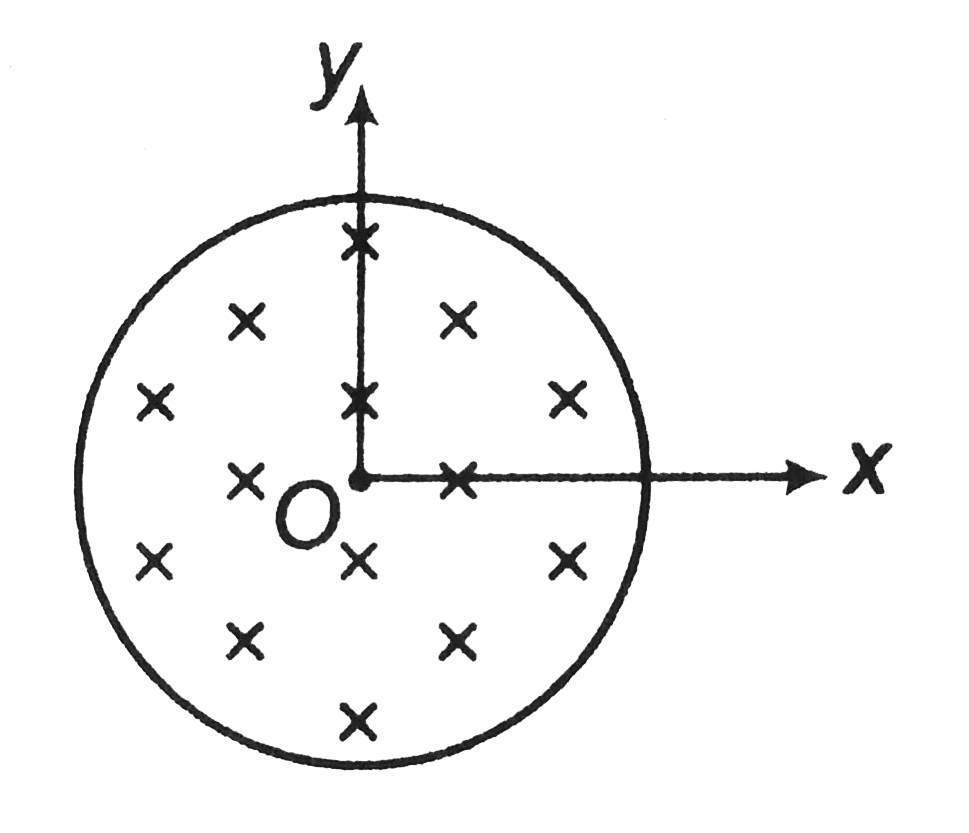
Magnetic field in cylindrical region of radius `R` in inward direction is as shown in figure.

Promotional Banner

Similar Questions

Explore conceptually related problems

In a region of space, magnetic field exists in a cylindrical region of radius a centred at origin with magnetic field along negative z-direction. The field is given by vecB=-B_(0)thatk . The force experienced by a stationary charge q placed at (r, 0, 0), where r gt a is

In a region of space, magnetic field exists in a cylindrical region of radius a centred at origin with magnetic field along negative z-direction. The field is given by vecB=-B_(0)thatk . The force experienced by a stationary charge q placed at (r, 0, 0), where r gt a is

Magnetic field B in a cylindrical region of radius r varies according to the law B = B_(0)t as shown in the figure. A fixed conducting loop ABCDA of resistance R is lying in the region as show . The current flowing through the loop is

Magnetic field B in a cylindrical region of radius r varies according to the law B = B_(0)t as shown in the figure. A fixed conducting loop ABCDA of resistance R is lying in the region as show . The current flowing through the loop is

A uniform but time varying magnetic field B=(2t^3+24t)T is present in a cylindrical region of radius R =2.5 cm as shown in figure. In the previous problem, the direction of circular electric lines at t=1 s is

A uniform but time varying magnetic field B=(2t^3+24t)T is present in a cylindrical region of radius R =2.5 cm as shown in figure. In the previous problem, the direction of circular electric lines at t=1 s is

A uniform but time varying magnetic field B=(2t^3+24t)T is present in a cylindrical region of radius R =2.5 cm as shown in figure. The variation of electric field at any instant as a function of distance measured from the centre of cylinder in first problem is

A uniform but time varying magnetic field B=(2t^3+24t)T is present in a cylindrical region of radius R =2.5 cm as shown in figure. The variation of electric field at any instant as a function of distance measured from the centre of cylinder in first problem is