

Home
Class 11
PHYSICS
Two masses each equal to m are lying on ...

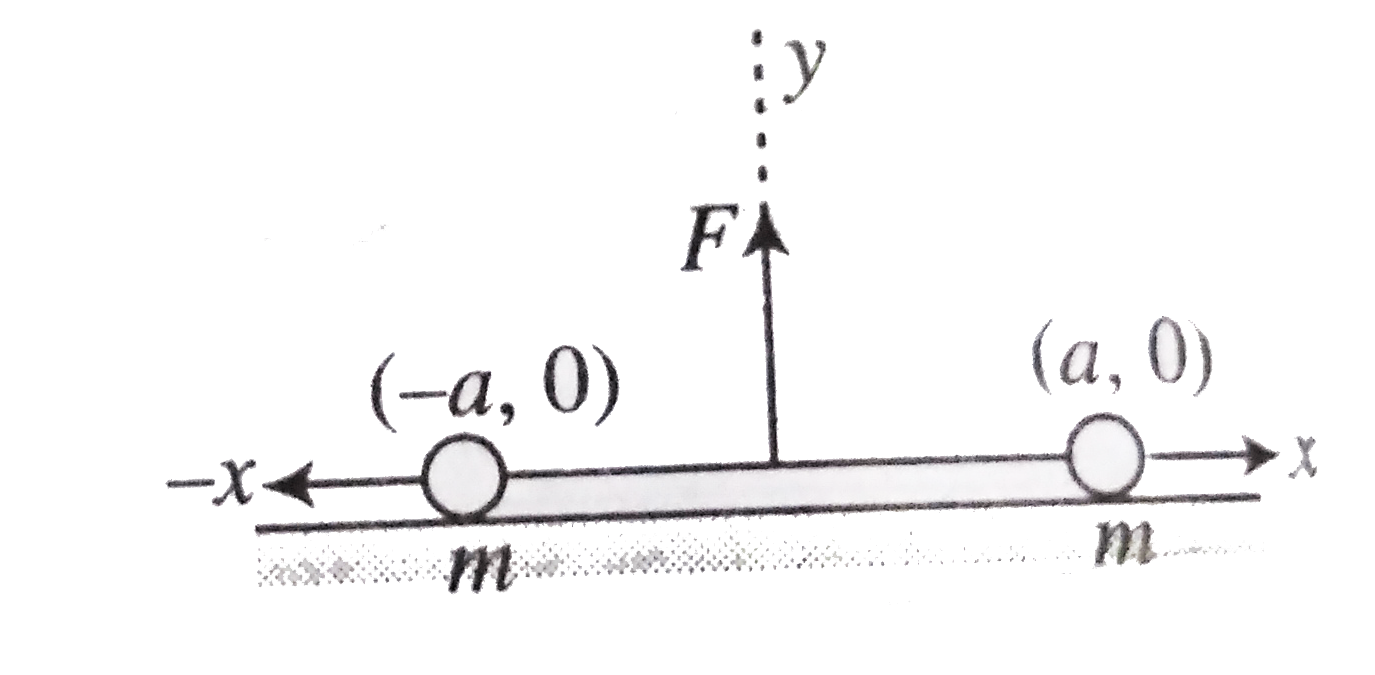
Two masses each equal to m are lying on x-axis at `(-a,0)(+a,0)` respectively as shown in figure They are connected by a light string A force F is applied at the origin along vertical direction As a result the masses move toward each other without loosing contact with ground What is the acceleration of each mass? Assume the instantanceous position of the masses as`(-x,0)`and `(x,0)`

Promotional Banner

Similar Questions

Explore conceptually related problems

Two identical point masses, each of mass M are connected to one another by a massless string of length L. A constant force F is applied at the mid-point of the string. If l be the instantaneous distance between the two masses, what will be the acceleration of each mass?

Two point masses, each of mass 'm' are connected to the end of spring. If force F is applied on one of the mass, then find the acceleration of this mass if the acceleration of other mass is a ?

Two masses m_1 and m_2 are placed on a smooth horizontal surface and are connected by a string of negligible mass. A horizontal force F is applied on the mass m_2 as shown in the figure. The tension in the string is

Two masses m_(1) and m_(2) are placed on a smooth horizontal surface and are connected by a string of negligible mass. A horizontal force F is applied on the mass m_(2) as shown in the figure. The tenison in the string is

Two bodies A and B each of mass M are fixed together by a massless spring A force F acts on the mass B as shown in fig At the instant shown the mass A has acceleration a. What is the acceleration of mass B?

Two particles each of mass m are connected by a light string of length 2L as shown in the figure. A constant force F is applied continuoulsly at the mid - point of the string at right - angle to intial position of the string. Find the acceleration of each particle and the acceleration of approach between the particles when separation between them is 2x

Two particles of mass m each are tied at the ends of a light string of length 2a. The whole system is kept on a frictionless horizontal surface with the string held tight so that each mass is at a distance a from the centre P (as shown in the figure). Now, the mid-point of the string is pulled vertically upwards with a small but constant force F. As a result, the particles move towards each other on the surface. The magnitude of acceleration, when the separation between them becomes 2x, is

Two particles of mass m each are tied at the ends of a light string of length 2a. The whole system is kept on a frictionless horizontal surface with the string held tight so that each mass is at a distance a from the centre P (as shown in the figure). Now, the mid-point of the string is pulled vertically upwards with a small but constant force F. As a result, the particles move towards each other on the surface. The magnitude of acceleration, when the separation between them becomes 2x, is