

Home
Class 12
PHYSICS
Persons A and B are standing on the oppo...

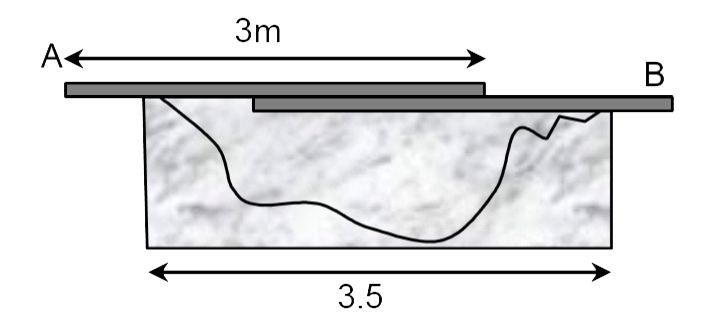
Persons A and B are standing on the opposite sides of a `3.5` m wide water stream which they wish to cross. Each one of them has a rigid wooden plank whose mass can be neglected. However, each plank is only slightly longer than 3 m. So they decide to arrange them together as shown in the figure schematically. With B (mass 17 kg) standing, the maximum mass of A, who can walk over the plank is close to

Promotional Banner

Similar Questions

Explore conceptually related problems

Two persons A and B are standing at the two opposite ends of a plank of length 4 m as shown in the figure. Plank is kept on a frictionless horizontal surface. Displacement of Plank, when A and B interchange their positions on the plank is (given m_A=40 kg, m_B= 60 kg, m_(plank) = 20 kg)

A man of mass m stands at the left end of a uniform plank of length L and mass M, which lies on a frictionaless surface of ice. If the man walks to the other end of the plank, then by what distance does the plank slide on the ice?

A man of mass m stands at the left end of a uniform plank of length L and mass M, which lies on a frictionaless surface of ice. If the man walks to the other end of the plank, then by what distance does the plank slide on the ice?

A man of mass m stands at the left end of a uniform plank of length L and mass M, which lies on a frictionaless surface of ice. If the man walks to the other end of the plank, then by what distance does the plank slide on the ice?

A man of mass m stands at the left end of a uniform plank of length L and mass M, which lies on a frictionaless surface of ice. If the man walks to the other end of the plank, then by what distance does the plank slide on the ice?

A man of mass m stands at the left end of a uniform plank of length L and mass M, which lies on a frictionaless surface of ice. If the man walks to the other end of the plank, then by what distance does the plank slide on the ice?

A man of mass M stands at one end of a plank of length L which lies at rest on a frictionless surface. The man walks to the other end of the planck. If the mass of the planck is M/2 , then the distance that the man moves relative to the ground is