

Home
Class 11
PHYSICS
An equilateral prism of mass m rests on ...

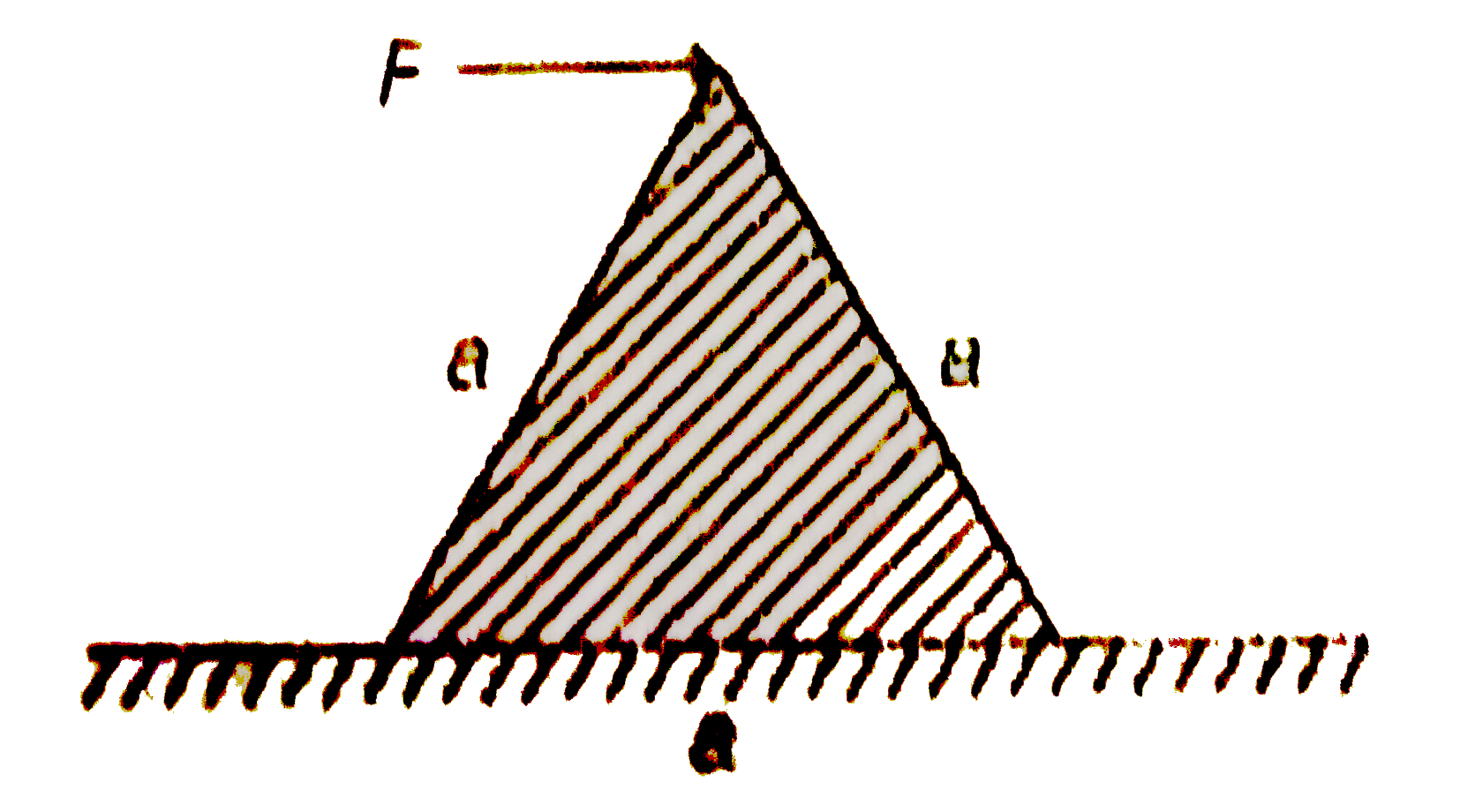
An equilateral prism of mass m rests on a rough horizontal surface with cofficent of friction `mu`. A horizontal force F is applied on the prism as shown in the figure. If the cofficent of the friction is sufficently high so that the prism does not slide before toppling, then the minimum force required to topple the prism is

Promotional Banner

Similar Questions

Explore conceptually related problems

An equilateral prism of mass m rests on a rough horizontal surface with coefficient of friction mu . A horizontal force F is applied on the prism as shown in figure. If the coefficient of friction is sufficiently high so that the prism does not slide before toppling, the minimum force required to topple the prism is

An equilateral prism of mass m rests on a rough horizontal surface with coefficient of friction mu . A horizontal force F is applied on the top of prism as shown in figure. If the coefficient of friction is sufficiently high so that the prism does not slide before topping, the minimum force required to topple the prism is

An equilateral prism of mass m rests on a rough horizontal surface with ceefficeint of friction mu . A horozontal force F is applied on the prism as shown. If the coefficeint of friction is sufficiently high so that the prism does not slide before toppling, the minimum force required to topple the prism is

A cubical block of side L rests on a rough horizonta surface with coefficient of friction mu . A horizontal force F is applied on the block as shown. If the coefficient of friction is sufficiently high so that the block does not slide before toppling, the minimum force required to topple the block is

A cubical block of side L rests on a rough horizontal surface with coefficient of friction mu . A horizontal force F is applied on the block as shown. If the coefficient of frictions sufficienty high so that the block does not slide before toppling, the minimum force required to topple the block is : .