

Home
Class 12
PHYSICS
Charges q(1) , q(2) and q(3) are placed ...

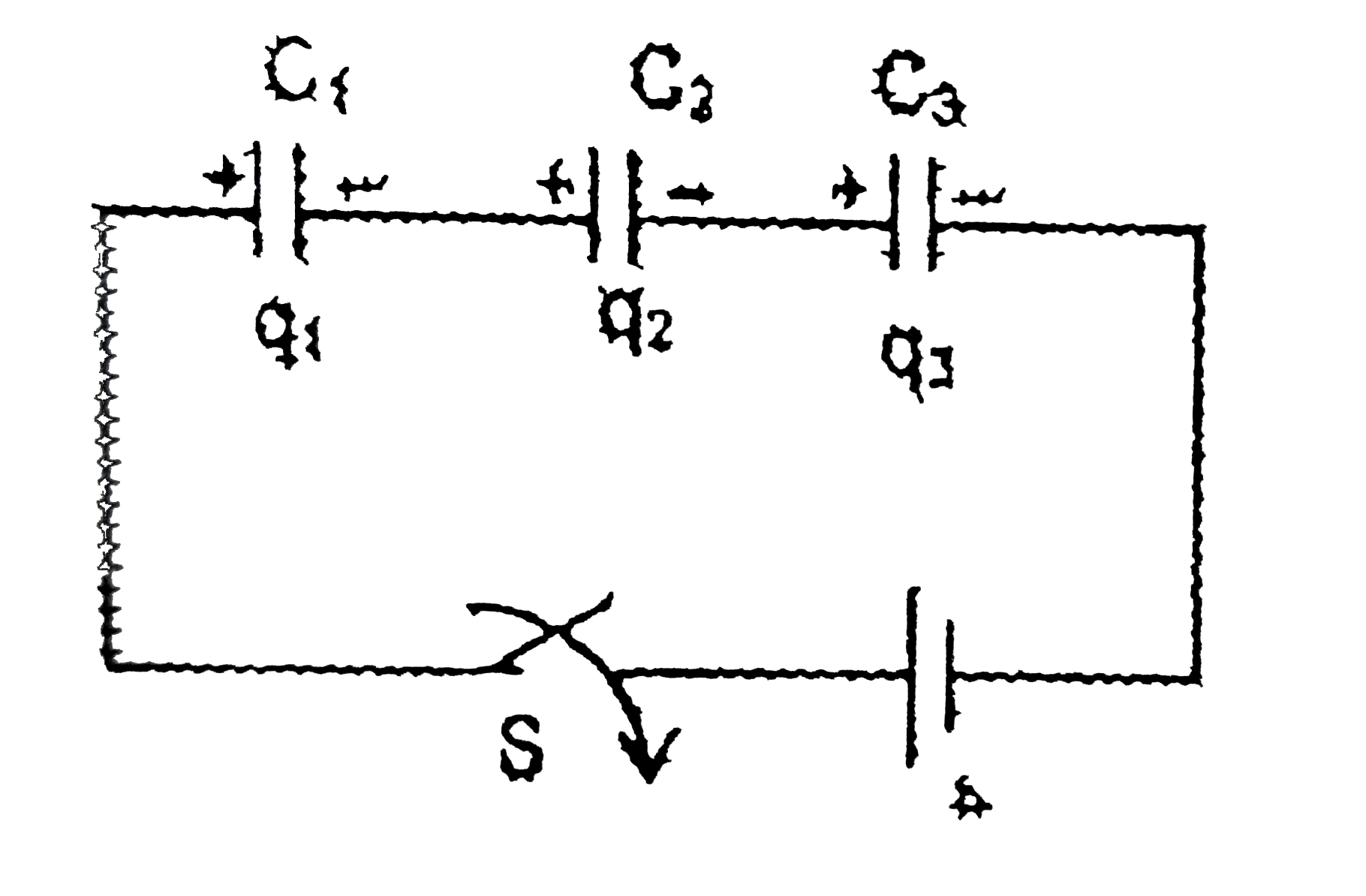
Charges `q_(1)` , `q_(2)` and `q_(3)` are placed on capacitors of capacitance `C_(1)`, `C_(2)` and `C_(3)`, respectively, arranged in series as shown. Switch `S` is there closed. What are the final charges `q'_(1)`, `q'_(2)` and `q'_(3)` on the capacitors?
Given `q_(1)=30muC`, `q_(2)=muC`, `q_(3)=10muC`, `C_(1)=10muF`, `C_(2)=20muF`, `C_(3)=30muF` and `epsilon=12"volt"`

Promotional Banner

Similar Questions

Explore conceptually related problems

The point charges q_(1)=1 muC,q_(2)=-2 muC and q_(3)=3 muC are placed at (1m,0,0),(0,2m,0) and (0,0,3m) respectively. Find the electric potential at origin.

In, the charges on C_(1),C_(2) , and C_(3) , are Q_(1), Q_(2) , and Q_(3) , respectively. .

In figure, the charges on C_(1),C_(2) , and C_(3) , are Q_(1), Q_(2) , and Q_(3) , respectively. .

The circuit shows two capacitors, C_(1) and C_(2) charged so as to have respectively charges q_(1) and q_(2) . The switch is closed . Which of the following choices are incorrect ?

Three point charge q_1=1muC, q_2=-2muC and q_3=3muC are placed at (1m, 0,0), (0,2m,0) and (0,0,3m) respectively. Find the electric potential at as origin.

Three point charge q_1=1muC, q_2=-2muC and q_3=3muC are placed at (1m, 0,0), (0,2m,0) and (0,0,3m) respectively. Find the electric potential at as origin.

A capacitor of capacity C having charge q and 3q , on the plate P_(1) and P_(2) respectively as shoen in figure. Now switch 'S' is closed, find the work done by the battery. (take q = CV )

A capacitor of capacity C having charge q and 3q , on the plate P_(1) and P_(2) respectively as shoen in figure. Now switch 'S' is closed, find the work done by the battery. (take q = CV )

wo capacitors of capacitances C_(1) and C_(2) are connected in parallel across a battery. If Q_(1) and Q_(2) respectively be the charges on the capacitors, then (Q_(1))/(Q^(2)) will be equal to

Two capacitors of capacitances C_(_1) and C_(2) are connected in parallel across a battery. If Q_(1) and Q_(2) respectively be the charges on the capacitors, then (Q_(1))/(Q^(2)) will be equal to