

Home
Class 11
PHYSICS
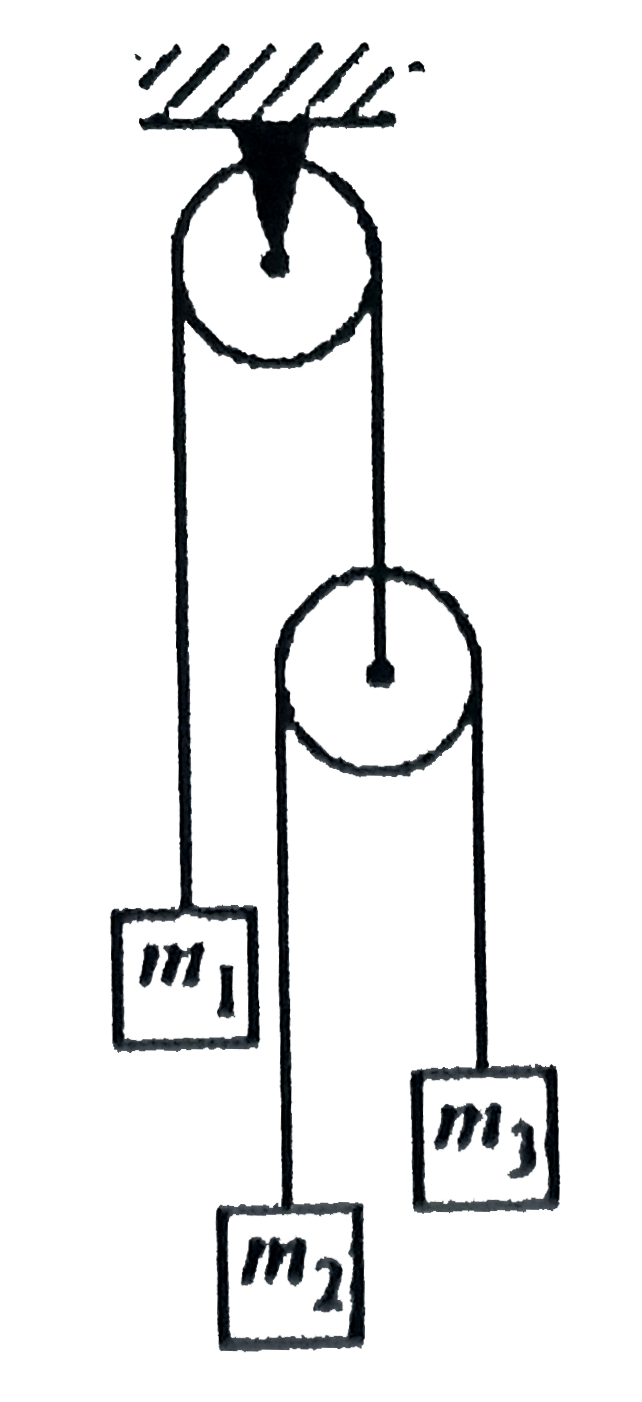
Consider the system ofpulleysasshown in ...

Consider the system ofpulleysasshown in figure-2.197. Find the acceleration of the three masses `m^(1),m^(2)` and `m^(3). (m_(1) = I kg,m_(2) = 2kg " and " m_(3) =3kg)`

Promotional Banner

Similar Questions

Explore conceptually related problems

In the system shown in fig., all pulleys are mass less and the string is inextensible and light. (a) After the system is released, find the acceleration of mass m_(1) (b) If m_(1) = 1 kg, m_(2) = 2 kg "and" m_(3) = 3 kg then what must be value of mass m_(4) so that it accelerates downwards?

Three blocks, placed on smooth horizontal surface are connected by ideal string and a disc shaped pulley of radius r, and mass m. Find the accelerations of the blocks. Masses of the blocks are given as M_(1) = 10kg, M_(2) = 5 kg , M_(3) = 2kg, m = 2kg .

There blocks of masses m_(1),m_(2) and m_(3) are connected by massless strings as shown in figure on a frictionless table. They are pulled with a force T_(3)=50 N. If m_(1)=10 kg, m_(2)=6 kg and m_(3)=2 kg, the tension T_(2) will be

In the figure shown, m_(1) = 10kg, m_(2) = 6kg, m_(3) = 4kg. If T_(3) = 40 N, T_(2) = ?

In the figure shown, m_(1) = 10kg, m_(2) = 6kg, m_(3) = 4kg. If T_(3) = 40 N, T_(2) = ?

Consider the system of masses and pulleys shown in fig. with massless string and fricitionless pulleys. (a) Give the necessary relation between masses m_(1) and m_(2) such that system is in equilibrium and does not move. (b) If m_(1)=6kg and m_(2)=8kg , calculate the magnitude and direction of the acceleration of m_(1) .

Consider the system of masses and pulleys shown in fig. with massless string and fricitionless pulleys. (a) Give the necessary relation between masses m_(1) and m_(2) such that system is in equilibrium and does not move. (b) If m_(1)=6kg and m_(2)=8kg , calculate the magnitude and direction of the acceleration of m_(1) .