


Topper's Solved these Questions
LINES AND ANGLES
NCERT TELUGU|Exercise DO THESE|8 VideosLINES AND ANGLES
NCERT TELUGU|Exercise TRY THIS|4 VideosLINES AND ANGLES
NCERT TELUGU|Exercise EXERCISE XERCISE - 4.3|19 VideosLINEAR EQUATIONS IN TWO VARIABLES
NCERT TELUGU|Exercise EXERCISE 8.5|6 VideosPOLYNOMIALS AND FACTORISATION
NCERT TELUGU|Exercise TRY THESE|6 Videos
Similar Questions
Explore conceptually related problems
NCERT TELUGU-LINES AND ANGLES -EXERCISE XERCISE - 4.4
- In the given triangles, find out x, y and z.
Text Solution
|
- In the given figure AS || BT, angle4 = angle5 bar(SB) bisects angleAST...
Text Solution
|
- In the given figure AB || CD, BC || DE then find the values of x and y
Text Solution
|
- In the adjacent figure BE bot DA and CDbotDA then prove that mangle1 ~...
Text Solution
|
- Find the values of x, y for which the lines AD and BC become parallel.
Text Solution
|
- Find the values of x and y in the figure .
Text Solution
|
- If the segments shown by arrow heads are parallel. Find the values of ...
Text Solution
|
- In the given figure sides QP and RQ of ΔPQR are produced to points S a...
Text Solution
|
- From the figure find x and y.
Text Solution
|
- In the given figure if AB || DE, angleBAC = 35^(@) and angleCDE = 53^...
Text Solution
|
- In the given figure if line segments PQ and RS intersect at point T, s...
Text Solution
|
- In the adjacent figure, ABC is a triangle in which angleB = 50^(@) and...
Text Solution
|
- In the given figure if PQ bot PS, PQ || SR, angleSQR = 28^(@) and angl...
Text Solution
|
- In the given figure triangleABC side AC has been produced to D. angleB...
Text Solution
|
- In the adjacent figure, it is given that, BC || DE, angleBAC = 35^@ an...
Text Solution
|
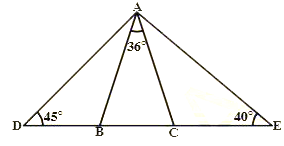
- In the adjacent figure, it is given that AB =AC, angleBAC = 36^(@) , a...
Text Solution
|
- Using information given in the figure, calculate the value of x and y
Text Solution
|