Home
Class 9
MATHS
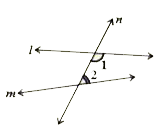
In the adjacent figure, a line n falls o...

In the adjacent figure, a line n falls on lines l and m such that the sum of the interior angles 1 and 2 is less than 180°, then what can you say about lines l and m.

Text Solution

Verified by Experts

The correct Answer is:

Lines intersect on the side of the angle less than `180^(@)`
Promotional Banner

Topper's Solved these Questions

  • THE ELEMENTS OF GEOMETRY

    NCERT BANGLISH|Exercise BRAIN TEASER|2 Videos
  • THE ELEMENTS OF GEOMETRY

    NCERT BANGLISH|Exercise TRY THIS|1 Videos
  • SURFACE AREAS AND VOLUMES

    NCERT BANGLISH|Exercise EXERCISE 10.4|12 Videos
  • TRIANGLES

    NCERT BANGLISH|Exercise EXERCISE - 7.4|7 Videos

Similar Questions

Explore conceptually related problems

Consider three lines as follows. L_1:5x-y+4=0 L_2:3x-y+5=0 L_3: x+y+8=0 If these lines enclose a triangle A B C and the sum of the squares of the tangent to the interior angles can be expressed in the form p/q , where p and q are relatively prime numbers, then the value of p+q is

In the adjacent figure m || n. A, B are any two points on m and n respectively. Let ‘C’ be an interior, point between the lines m and n. Find angleACB .

theta_1 and theta_2 are the inclination of lines L_1 and L_2 with the x-axis. If L_1 and L_2 pass through P(x_1,y_1) , then the equation of one of the angle bisector of these lines is

If 7l^2 - 9m^2 + 8l + 1 = 0 and we have to find equation of circle having lx + my + 1 = 0 is a tangent and we can adjust given condition as 16l^2 + 8l + 1 = 9(l^2 + m^2) or (4l^2 + 1)^2 = 9(l^2 + m^2) implies |4l + 1|/sqrt ((l^2 + m^2)) = 3 Centre of circle = (4, 0) and radius = 3 when any two non parallel lines touching a circle, then centre of circle lies on angle bisector of lines. Answer the following question based on above passage : If 16m^2 - 8l - 1 = 0 , then equation of the circle having lx + my + 1 = 0 is a tangent is

In the diagram as shown, a circle is drawn with centre C(1,1) and radius 1 and a line L. The line L is tangent to the circle at Q. Further L meets the y-axis at R and the x-axis at P in such a way that the angle OPQ equals theta where 0 lt theta lt (pi)/(2) . Coordinate of Q is

Let a given line L_1 intersect the X and Y axes at P and Q respectively. Let another line L_2 perpendicular to L_1 cut the X and Y-axes at Rand S, respectively. Show that the locus of the point of intersection of the line PS and QR is a circle passing through the origin

In the DeltaPQR , a straight line parallel to QR intersects the sides PQ and PR at the points L and M . If PL=n . PL and LQ=(p+1)LQ , then n-p=

P is a point equidistant from two lines l and m intersecting at point A (see figure). Show that the line AP bisects the angle between them.

A variable line in two adjacent positions has direction cosines l, m, n and l+delta l, m+deltam, n+delta n . Prove that the small angle delta theta between the two positions of the variable line is given by, (delta theta)^(2)=(delta l)^(2)+(delta m)^(2)+(delta n)^(2)

Straight lines are drawn by joining m points on a straight line of n points on another line. Then excluding the given points, the number of point of intersections of the lines drawn is (no tow lines drawn are parallel and no these lines are concurrent). a. 4m n(m-1)(n-1) b. 1/2m n(m-1)(n-1) c. 1/2m^2n^2 d. 1/4m^2n^2
