

Home
Class 9
MATHS
ABCD is a parallelogram AP and CQ are pe...

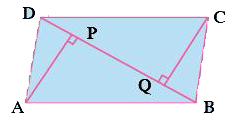
ABCD is a parallelogram AP and CQ are perpendiculars drawn from vertices A and C on diagonal BD (see figure) show that
(i) `DeltaAPB ~= DeltaCQD`
(ii) `AP = CQ`

Promotional Banner

Topper's Solved these Questions

  • QUADRILATERALS

    NCERT BANGLISH|Exercise EXERCISE - 8.4|6 Videos
  • QUADRILATERALS

    NCERT BANGLISH|Exercise EXERCISE - 8.2|3 Videos
  • PROOFS IN MATHEMATICS

    NCERT BANGLISH|Exercise EXERCISE - 15.4|15 Videos
  • REAL NUMBERS

    NCERT BANGLISH|Exercise EXERCISE - 1.4|37 Videos

Similar Questions

Explore conceptually related problems

ABC is a triangle in which altitudes BD and CE to sides AC and AB are equal (see figure) . Show that (i) DeltaABD ~= DeltaACE (ii) AB = AC i.e., ABC is an isosceles triangle.

In right triangle ABC, right angle is at C, M is the mid-point of hypotenuse AB. C is joined to M and produced to a point D such that DM = CM. Point D is joined to point B (see figure). Show that : (i) DeltaAMC ~= DeltaBMD (ii) /_DBC is a right angle (iii) Delta DBC ~= DeltaACB (iv) CM = 1/2 AB .

ABCD is a parallelogram. AC and BD are the diagonals intersect at O. P and Q are the points of tri section of the diagonal BD. Prove that CQ" ||" AP and also AC bisects PQ (see figure).

In Delta^(s)ABC and, AB"||"DE, AB=DE, BC=EF and BC"||"EF . Vertices A, B and C are joined to vertices D, E and F respectively (see figure). Show that (i) ABED is a parallelogram (ii) BCFE is a parallelogram (iii) AC = DF (iv) DeltaABC~=DeltaDEF

P is any point on BC of the square ABCD. The perpendicular , drawn from B to AP intersects DC at Q . Prove that AP = BQ.

P is a point equidistant from two lines l and m intersecting at point A (see figure). Show that the line AP bisects the angle between them.

ABC is an isosceles triangle in which AB = AC. AD bisects exterior angle QAC and CD "||" BA as shown in the figure. Show that (i) angleDAC = angleBCA (ii) ABCD is a parallelogram

ABCD is a parallelogram and P is the mid-point of bar(DC) . If Q is a point on bar(AP) , such that bar(AQ)=2/3bar(AP) , show that Q lies on the diagonal bar(BD) " and " bar(BQ)=2/3bar(BD) .

ABCD is a quadrilateral. AP is a line segment drawn through A and parallel to the diagonal BD, which intersects extended CD at P. If the area of the quadrilateral be 22 sq.cm, then find the value of 1/2DeltaBCP .

Two perpendicular BD and CE are drawn from the vertices B and C respectively on the sides AC and AB of the Delta ABC ,which intersect each other at the point P. Prove that AC^(2) + BP^(2) = AB^(2) + CP^(2)