

Home
Class 9
MATHS
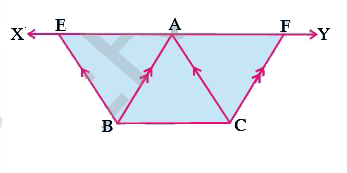
In the figure, XY is a line parallel to ...

In the figure, XY is a line parallel to BC is drawn through A. If BE || CA and CF || BA are drawn to meet XY at E and F respectively. Show that `ar(DeltaABE) = ar (DeltaACF).`

Promotional Banner

Topper's Solved these Questions

  • AREAS

    NCERT BANGLISH|Exercise EXERCISE 11.2|9 Videos
  • CIRCLES

    NCERT BANGLISH|Exercise EXERCISE 12.5|5 Videos

Similar Questions

Explore conceptually related problems

In the adjacent figure ABCD is a parallelogram and E is the midpoint of the side BC. If DE and AB are produced to meet at F, show that AF = 2AB .

Draw two triangles ABC and DBC on the same base and between the same parallels as shown in the figure with P as the point of intersection of AC and BD. Draw CE || BA and BF || CD such that E and F lie on line AD. Can you show ar(DeltaPAB) = ar(DeltaPDC) Hint : These triangles are not congruent but have equal areas.

ABCD is a quadrilateral. AC is the diagonal and DE || AC and also DE meets BC produced at E. Show that ar(ABCD) = ar (DeltaABE).

Let the base A B of a triangle A B C be fixed and the vertex C lies on a fixed circle of radius rdot Lines through Aa n dB are drawn to intersect C Ba n dC A , respectively, at Ea n dF such that C E: E B=1:2a n dC F : F A=1:2 . If the point of intersection P of these lines lies on the median through A B for all positions of A B , then the locus of P is (a) a circle of radius r/2 (b) a circle of radius 2r (c) a parabola of latus rectum 4r (d) a rectangular hyperbola

In trapezium ABCD , AB and DC are parallel. A straight line parallel to AB intersects AD and BC at the points E and F respectively. Prove that DE:EA=CF:FB .

In the figure, ABCDE is a pentagon. A line through B parallel to AC meets DC produced at F. Show that (i) ar (DeltaACB) = ar (DeltaACF) (ii) ar (AEDF) = ar (ABCDE)

In the figure D, E are points on the sides AB and AC respectively of DeltaABC such that ar(DeltaDBC) = ar(DeltaEBC) . Prove that DE || BC.

A straight line drawn through D of the parallelogram ABCD intersects AB and the extended part of CB at the points E and F respectively. Prove that AD:AE=CF:CD .

Let A(p^2,-p),B(q^2, q),C(r^2,-r) be the vertices of triangle ABC. A parallelogram AFDE is drawn with D,E, and F on the line segments BC, CA and AB, respectively. Using calculus, show that the maximum area of such a parallelogram is 1/2(p+q)(q+r)(p-r) .

In the figure, ΔABC, D, E, F are the midpoints of sides BC, CA and AB respectively. Show that (i) BDEF is a parallelogram (ii) ar(DeltaDEF)=1/4ar(DeltaABC) (iii) ar(BDEF)=1/2ar(DeltaABC)