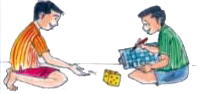
In rolling a die . Suppose the second player got a six on the top face. Does it mean that the third player would not have a chance of getting a six on the top face?
Topper's Solved these Questions
PROBABILITY
NCERT BANGLISH|Exercise DO THIS|3 Videos
PROBABILITY
NCERT BANGLISH|Exercise TRY THESE|7 Videos
POLYNOMIALS AND FACTORISATION
NCERT BANGLISH|Exercise TRY THESE|6 Videos
PROOFS IN MATHEMATICS
NCERT BANGLISH|Exercise EXERCISE - 15.4|15 Videos
Similar Questions
Explore conceptually related problems
In rolling a die . Does the first player have a greater chance of getting a six on the top face?
In rolling a die . Would the player who played after him have a lesser chance of getting a six on the top face?
In a hexaonal system system of cycstals, a frequently encountered arrangement of atoms is described as a hexagonal prism. Here, the top and bottom of the cell are refular hexagons, and three atoms are sandwiched in between them. A space-cilling model of this structure, called hexagonal close-paked is constituted of a sphere on a flat surface surrounded in the same plane by six identical spheres as closely as possible. Three spherres are then placed overt the first layer so that they toych each other and represent the second layer so that they toych each other and present the second layer. Each one of the three spheres touches three spheres of the bottom layer. Finally, the second layer is convered with a third layer identical to the bottom layer in relative position. Assume the radius of every sphere to be r . The number of atom in this hcp unit cell is
In a hexaonal system system of cycstals, a frequently encountered arrangement of atoms is described as a hexagonal prism. Here, the top and bottom of the cell are refular hexagons, and three atoms are sandwiched in between them. A space-cilling model of this structure, called hexagonal close-paked is constituted of a sphere on a flat surface surrounded in the same plane by six identical spheres as closely as possible. Three spherres are then placed overt the first layer so that they toych each other and represent the second layer so that they toych each other and present the second layer. Each one of the three spheres touches three spheres of the bottom layer. Finally, the second layer is convered with a third layer identical to the bottom layer in relative position. Assume the radius of every sphere to be r . The empty space in this hcp unit cell is
A coin and a six faced die, both unbiased, are thrown simultaneously. The probability of getting a head on the coin and an odd number on the die is -
A coin an a six faced die both unbiased are thrown simulaneously. The probability of getting a head on the coin and an odd number on the die is-
In hexagonal systems of crystals, a frequently encountered arrangement of atoms is described as a hexagonal prism. Here, the top and bottom of the cell are regular hexagons and three atoms are sandwiched in between them. A space-filling model of this structure, called hexagonal close-packed (HCP), is constituted of a sphere on a flat surface surrounded in the same plane by six identical spheres as closely as possible. Three spheres are then placed over the first layer so that they touch each other and represent the second layer. Each one of these three spheres touches three spheres of the bottom layer. Finally, the second layer is covered with a third layer that is identical to the bottom layer in relative position. Assume radius of every sphere to be ‘r’. The volume of this HCP unit cell is
Classify the following statements into the categories less likely, equally likely, more likely. a) Rolling a die* and getting a number 5 on the top face. b) Cold waves in your village in the month of November. c) India winning the next soccer(foot ball)world cup d) Getting a tail or head when a coin is tossed. e) Winning the jackpot for your lottery ticket
A die has six faces numbered from 1 to 6. It is rolled and the number on the top face is noted. When this is treated as a random trial. a) What are the possible outcomes ? b)Are they equally likely? Why? c) Find the probability of a composite number turning up on the top face.
On a normal standard die one of the 21 dots from any one of the six faces is removed at random with each dot equally likely to be chosen. If the die is then rolled, then find the porbability that the odd number appears.
NCERT BANGLISH-PROBABILITY -THINK, DISCUSS AND WRITE