Home
Class 11
PHYSICS
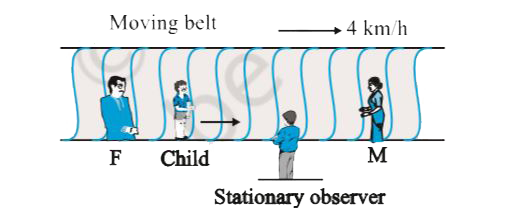
On a long horizontally moving belt (Fig....

On a long horizontally moving belt (Fig.), a child runs to and fro with a speed `9 km h^(-1)` (with respect to the belt) between his father and mother located 50 m apart on the moving belt. The belt moves with a speed of `4 km h^(-1)`. For an observer on a stationary platform outside, what is the
(a) speed of the child running in the direction of motion of the belt ?.
(b) speed of the child running opposite to the direction of motion of the belt ?
(c ) time taken by the child in (a) and (b) ?
Which of the answers alter if motion is viewed by one of the parents ?

Text Solution

Verified by Experts

(a) `13 km h^(-1)`, (b) `5 km h^(-1)`, (c ) 20 s in either direction, viewed by any one of the parents, the speed of the child is 9 km h–1 in either direction, answer to (c) is unaltered.
Promotional Banner

Topper's Solved these Questions

  • MOTION IN A STRAIGHT LINE

    NCERT BANGLISH|Exercise EXERCISES|21 Videos
  • MOTION IN A PLANE

    NCERT BANGLISH|Exercise EXCERCISES|30 Videos
  • OSCILLATIONS

    NCERT BANGLISH|Exercise Additional Exercises|6 Videos

Similar Questions

Explore conceptually related problems

A car moving with a speed of 50 "km.h"^(-1) can be stopped by brakes after at least 6 m. What will be the minimum stopping distance, if the same car is moving at a speed of 100 "km.h"^(-1) ?

A vehicle is moving with a uniform speed of 18 "km.h"^(-1) . The distance covered by it in 1 s is

A car moves with a speed of 30 "km.h"^(-1) in half of the total time taken and with 40 "km.h"^(-1) rest of the time, What is the average speed of the body?

A man travels a certain distance with a uniform speed of 5 km/h ad returns the same distance with a uniform speed of 4km/h. What is the average speed of the man?

A car moving with a speed of 50 km/hr can stopped by brakes, over a distance of 6 m. If the same car is moving at a speed of 100 km/hr. the stopping distance is

A car is moving along a circular path of radius 20 m with a speed of 40 km cdot h^(-1) . Find its angular velocity.
