Home
Class 11
PHYSICS
Show that the angular momentum about any...

Show that the angular momentum about any point of a single particle moving with constant velocity remains constant throughout the motion.

Text Solution

Verified by Experts
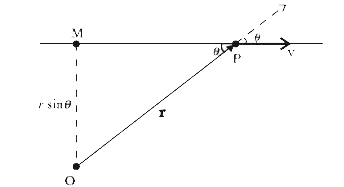
Let the particle with velocity v be at point P at some instant t. We want to calculate the angular momentum of the particle about an arbitrary point O.

The angular momentum is `l = r × mv`. Its magnitude is `mvr sin θ` , where `θ` is the angle between r and v as shown in Fig. 7.19. Although the particle changes position with time, the line of direction of v remains the same and hence `OM = r sin θ` . is a constant.
Further, the direction of l is perpendicular to the plane of r and v. It is into the page of the figure.This direction does not change with time.
Thus, l remains the same in magnitude and direction and is therefore conserved. Is there any external torque on the particle?
Promotional Banner

Topper's Solved these Questions

  • SYSTEMS OF PARTICLES AND ROTATIONAL MOTION

    NCERT BANGLISH|Exercise EXERCISES|26 Videos
  • SYSTEMS OF PARTICLES AND ROTATIONAL MOTION

    NCERT BANGLISH|Exercise EXERCISES (TRUE OR FALSE)|3 Videos
  • OSCILLATIONS

    NCERT BANGLISH|Exercise Additional Exercises|6 Videos
  • THERMAL PROPERTIME OF MATTER

    NCERT BANGLISH|Exercise EXERCISES|30 Videos

Similar Questions

Explore conceptually related problems

What is the nature of the time-displacement graph for a particle moving with a constant velocity?

Why Mercury cell voltage remain constant throughout its life?

Can a particle have varying speed but a constant velocity?

Statement I : Distance between two particles moving with constant velocities always remains constant. Statement II : The relative motion between two particles moving with constant velocities always remains constant.

A charged particle would continue to move with a constant velocity in a region where.

Displacement of a moving particle is directly proportional to the square of the time duration. State whether the particle is moving at a constant velocity or at a constant acceleration.

Two particles move in the same straight line starting at the same moment from the same point in the same deirectin. The first moves with constant velocity u and the second starts from rest with constant acceletation f. Then

