

Home
Class 11
PHYSICS
Two identical discs of same radius R are...

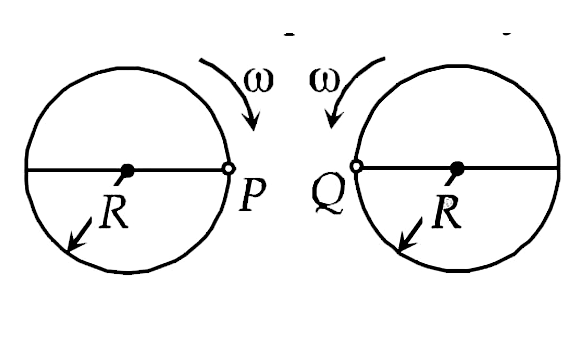
Two identical discs of same radius `R` are rotating about their axes in opposite directions with the same constant angular speed `omega` . The discs are in the same horizontal plane. At time `t = 0` , the points `P` and `Q` are facing each other as shown in the figure. The relative speed between the two points `P` and `Q` is `v_(r)`. In one time period `(T) ` of rotation of the discs , `v_(r)` as a function of time is best represented by

Promotional Banner

Similar Questions

Explore conceptually related problems

Two identical discs of same radius R are rotating about their axes in opposite directions with the same constant angular speed omega . The discs are in the same horizontal plane. At time t-0, the points P and Q are facing each other as shown in the figure. The relative speed between the two points P and Q is v_r , As a function of time, it is best represented by

A disc of radius R start at time t=0 moving along the positive X-axis with linear speed v and angular speed omega . Find the x and y-coordinates of the bottommost point at any time t.

A disc of radius R start at time t=0 moving along the positive X-axis with linear speed b and angular speed omega . Find the x and y-coordinates of the bottommost point at any time t.

A disc of radius R starts at time t=0 moving along the positive x-axis with linear speed v and angular speed omega . Find the x and y coordinates of the bottom most poitn at any time t .

Two particles P and Q are moving as shown in the figure. At this moment of time the angular speed of P w.r.t. Q is

Two particles P and Q are moving as shown in the figure. At this moment of time the angular speed of P w.r.t. Q is

Two cars are moving is one a same line dimension in opposite direction with the same speed v. The relative velocity of two cars w.r.t. each other is

Two cars are moving is one a same line dimension in opposite direction with the same speed v. The relative velocity of two cars w.r.t. each other is

Two point P and Q. diametrically opposite on a disc of radius R have linear velocities v and 2v as shown in figure. Find the angular speed of the disc.