

Home
Class 12
PHYSICS
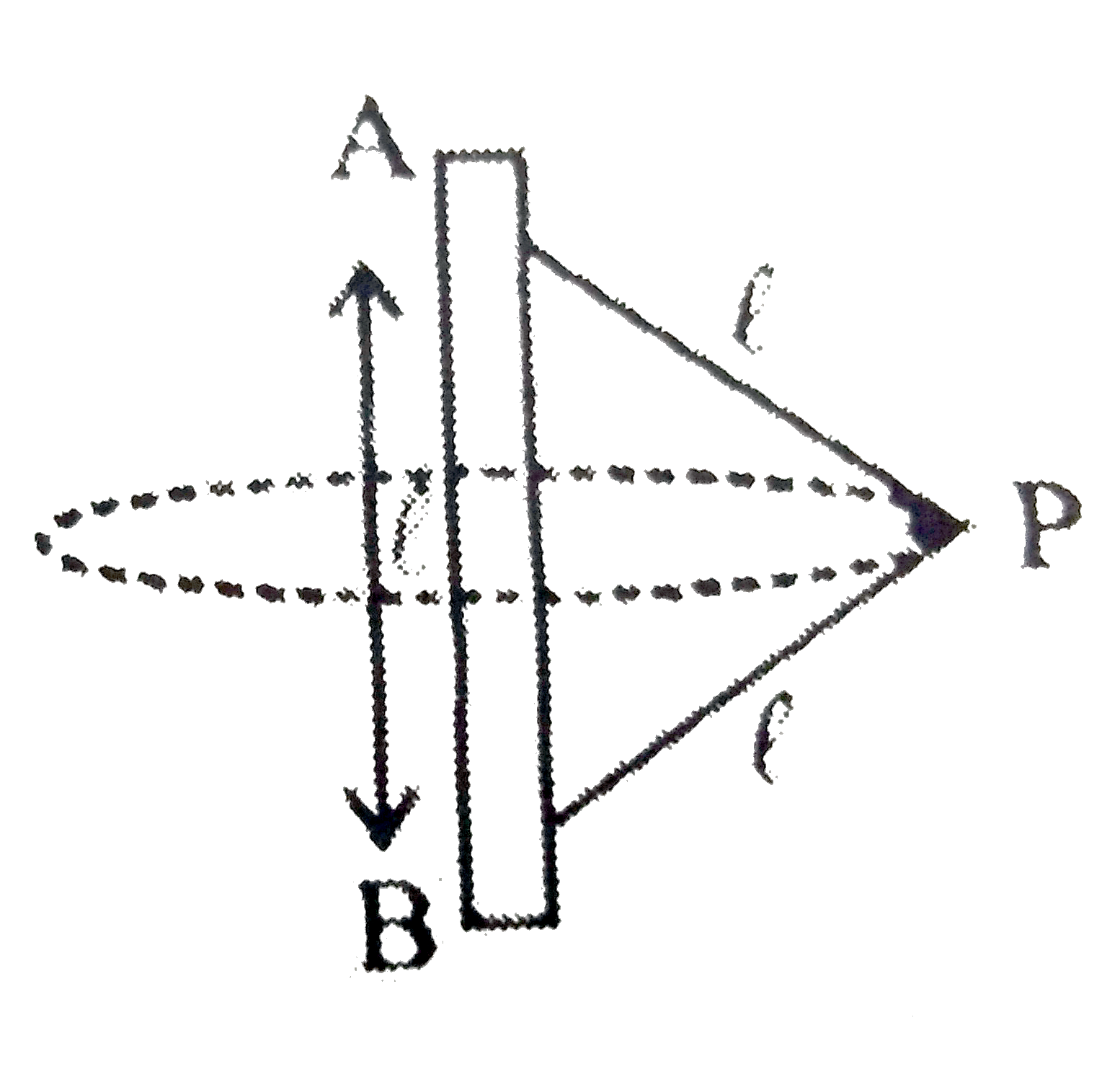
A particle P of mass m is attached to a ...

A particle P of mass m is attached to a vertical axis by two strings AP and BP of length l each. The separation AB=l. P rotates around the axis with an angular velocity `omega`. The tensions in the two strings are `T_(1) and T_(2)`

Promotional Banner

Similar Questions

Explore conceptually related problems

A particle P of mass m is attached to a vertical axis by two strings AP and BP of legth l each. The separation AB=l , rotates around the axis with an angular velocity omega . The tension in the two string are T_(1) and T_(2) . Then

A particle A of mass m is attached to a vertical axis by two stings PA and QA of lengths 3L and 4L , respectively. PQ=5L . A rotates around the axis with an angular speed omega . The tension in the two strings are T_(1) and T_(2) . (i) T_(1)=T_(2) (ii) 3T_(1)-4T_(2)=5mg (iii) 4T_(1)+3T_(2)=12momega^(2)L

Two masses M and m are attached to a vertical axis by weightless threads of combined length l . They are set in rotational motion in a horizontal plane about this axis with constant angular velocity omega . If the tensions in the threads are the same during motion, the distance of M from the axis is

A particle of mass m is attached to a vertical rod with two inextensible strings AO and BO of equal lengths l. Distance between A and B is also l. The setup is rotated with angular speed omega with rod as the axis.

A particle of mass m is attached to a vertical rod with two inextensible strings AO and BO of equal lengths l. Distance between A and B is also l. The setup is rotated with angular speed omega with rod as the axis. (a) Find the values of omega for which the particle remains at point B. (b) Find the range of values of omega for which tension (T_(1)) in the string AO is greater than mg but the other string remains slack (c) Find the value of omega for which tension (T_(1)) in string AO is twice the tension (T_(2)) in string BO (d) Assume that both strings are taut when the string AO breaks. What will be nature of path of the particle moment after AO breaks ?

The particle P of mass m is attached to two light, rigid rods AP and BP of length l each. A and B are hings on a fixed vertical axis. The system APB can rotate freely about this axis. The angle ABP = the angle BAP = theta . The tensions in AP and BP are T_(1) and T_(2) respectively. When the system is at rest, which of the following is not correct?