

Home
Class 12
PHYSICS
The rate at which a particular decay pro...

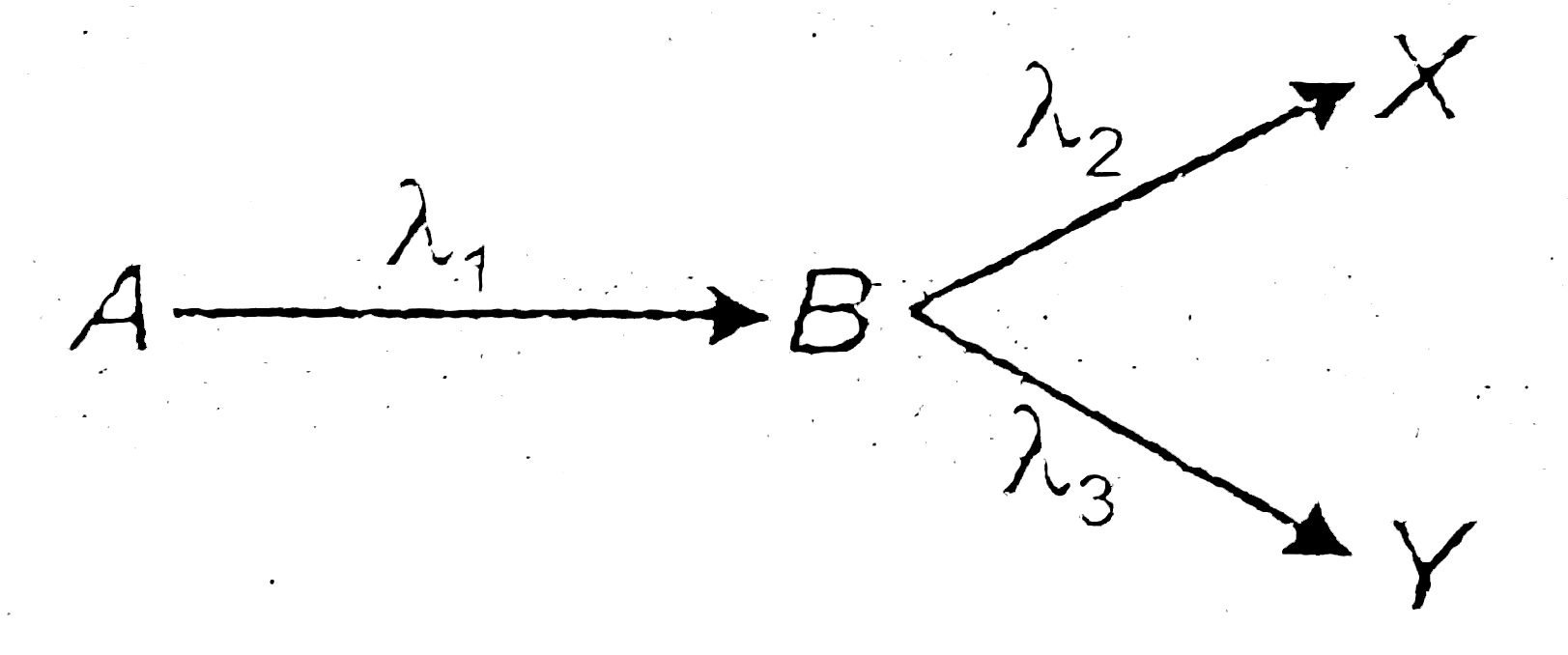
The rate at which a particular decay process occurs in a radio sample, is proportional to the number of radio active nuclei present . If N is the number of radio active nuclei present at some instant, the rate of change of N is `"dN"/"dt"=-lambdaN`. Consider radioactive decay of A to B which may further decay either to X or to Y, `lambda_1, lambda_2 and lambda_3` are decay constants for A to B decay , B to X decay and B of Y decay respectively. if at t=0 number of nuclei of A,B , X and Y are `N_0, N_0`,zero and zero respectively

and `N_1 , N_2, N_3,N_4` are number of nuclei A,B , X and Y at any instant.
The number of nuclei of B will first increase then after a maximum value, it will decreases, if

Promotional Banner

Similar Questions

Explore conceptually related problems

The rate at which a particular decay process occurs in a radio sample, is proportional to the number of radio active nuclei present . If N is the number of radio active nuclei present at some instant, the rate of change of N is "dN"/"dt"=-lambdaN . Consider radioactive decay of A to B which may further decay either to X or to Y, lambda_1, lambda_2 and lambda_3 are decay constants for A to B decay , B to X decay and B of Y decay respectively. if at t=0 number of nuclei of A,B , X and Y are N_0, N_0 ,zero and zero respectively and N_1 , N_2, N_3,N_4 are number of nuclei A,B , X and Y at any instant. Rate of accumulation of B of any instant will be

The rate at which a particular decay process occurs in a radio sample, is proportional to the number of radio active nuclei present . If N is the number of radio active nuclei present at some instant, the rate of change of N is "dN"/"dt"=-lambdaN . Consider radioactive decay of A to B which may further decay either to X or to Y, lambda_1, lambda_2 and lambda_3 are decay constants for A to B decay , B to X decay and B of Y decay respectively. if at t=0 number of nuclei of A,B , X and Y are N_0, N_0 ,zero and zero respectively and N_1 , N_2, N_3,N_4 are number of nuclei A,B , X and Y at any instant. At t=oo , which of the following is incorrect ?

The rate at which a particular decay process occurs in a radio sample, is proportional to the number of radio active nuclei present . If N is the number of radio active nuclei present at some instant, the rate of change of N is "dN"/"dt"=-lambdaN . Consider radioactive decay of A to B which may further decay either to X or to Y, lambda_1, lambda_2 and lambda_3 are decay constants for A to B decay , B to X decay and B of Y decay respectively. if at t=0 number of nuclei of A,B , X and Y are N_0, N_0 ,zero and zero respectively and N_1 , N_2, N_3,N_4 are number of nuclei A,B , X and Y at any instant. At t=oo , which of the following is incorrect ?

The rate at which a particular decay process occurs in a radio active sample, is proportional to the number of radio active nuclei present. If N is the number of radio active nuclei present at some instant, the rate of change of N is (dN)/(dt) = - lambdaN . Consider radioavtive decay of A to B which may further decay, either to X or to Y, lambda_(1),lambda_(2) and lambda_(3) are decay constants for A to B decay, B to X decay and B of Y decay respectively. If at t = 0 number of nuclei of A, B, X and Y are N_(0), N_(0) , zero and zero respectively and N_(1),N_(2),N_(3),N_(4) are number of nuclei A,B,X and Y at any intant. At t = oo , which of the following is incorrect ?

The rate at which a particular decay process occurs in a radio active sample, is proportional to the number of radio active nuclei present. If N is the number of radio active nuclei present at some instant, the rate of change of N is (dN)/(dt) = - lambdaN . Consider radioavtive decay of A to B which may further decay, either to X or to Y, lambda_(1),lambda_(2) and lambda_(3) are decay constants for A to B decay, B to X decay and B of Y decay respectively. If at t = 0 number of nuclei of A, B, X and Y are N_(0), N_(0) , zero and zero respectively and N_(1),N_(2),N_(3),N_(4) are number of nuclei A,B,X and Y at any intant. At t = oo , which of the following is incorrect ?

Consider radioactive decay of A to B with which further decays either to X or Y , lambda_(1), lambda_(2) and lambda_(3) are decay constant for A to B decay, B to X decay and Bto Y decay respectively. At t=0 , the number of nuclei of A,B,X and Y are N_(0), N_(0) zero and zero respectively. N_(1),N_(2),N_(3) and N_(4) are the number of nuclei of A,B,X and Y at any instant t . The number of nuclei of B will first increase and then after a maximum value, it decreases for

Consider radioactive decay of A to B with which further decays either to X or Y , lambda_(1), lambda_(2) and lambda_(3) are decay constant for A to B decay, B to X decay and Bto Y decay respectively. At t=0 , the number of nuclei of A,B,X and Y are N_(0), N_(0) zero and zero respectively. N_(1),N_(2),N_(3) and N_(4) are the number of nuclei of A,B,X and Y at any instant t . The number of nuclei of B will first increase and then after a maximum value, it decreases for