

Home
Class 12
PHYSICS
A uniform rod AB which is free to swing ...

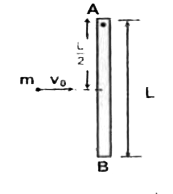
A uniform rod AB which is free to swing in the vertical plane about a horizontal axis through A, is hanging freely. A particle of equal mass strikes the rod with a velocity `v_(0)` and gets stucks to it. Find the angular velocity of the combination immediately after the collision.

Promotional Banner

Similar Questions

Explore conceptually related problems

A uniform rod of mass M and length L, which is free to rotate about a fixed vertical axis through O, is lying on a frictionless horizontal table. A particle of equal mass strikes the rod with a velocity V_(0) and sticks to it. The angular velocity of the combination immediately after the collision is:

A uniform rod of length L is free to rotate in a vertical plane about a fixed horizontal axis through B . The rod begins rotating from rest. The angular velocity omega at angle theta is given as

A uniform rod of legth L is free to rotate in a vertica plane about a fixed horizontal axis through B . The rod begins rotating from rest. The angular velocity omega at angle theta is given as

A uniform rod of legth L is free to rotate in a vertica plane about a fixed horizontal axis through B . The rod begins rotating from rest. The angular velocity omega at angle theta is given as

A uniform rod AB of length L and mass M is lying on a smooth table. A small particle if mass m strike the rod with velocity v_(0) at point C at a distance comes to rest after collision. Then find the value of x , so that point A of the rod remains stationary just after collision. .

A uniform rod AB of length L and mass M is lying on a smooth table. A small particle if mass m strike the rod with velocity v_(0) at point C at a distance comes to rest after collision. Then find the value of x , so that point A of the rod remains stationary just after collision. .

A rod of length l forming an angle theta with the horizontal strikes a frictionless floor at A with its centre of mass velocity v_(0) and no angular velocity. Assuming that the impact at A is perfectly elastic. Find the angular velocity of the rod immediately after the impact.

A rod of length l forming an angle theta with the horizontal strikes a frictionless floor at A with its centre of mass velocity v_(0) and no angular velocity. Assuming that the impact at A is perfectly elastic. Find the angular velocity of the rod immediately after the impact.

A uniform rod of mass m and length L is free to rotate in the vertical plane about a horizontal axis passing through its end. The rod initially in horizontal position is released. The initial angular acceleration of the rod is: