

Home
Class 9
MATHS
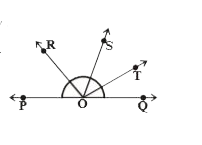
In the adjacent figure ray OS stands on ...

In the adjacent figure ray OS stands on a line PQ. Ray OR and ray OT are angle bisectors of `anglePOS` and `angleSOQ` respectively. Find `angleROT`.

Promotional Banner

Topper's Solved these Questions

  • LINES AND ANGLES

    NCERT KANNAD|Exercise EXERCISE XERCISE - 4.1|11 Videos
  • LINES AND ANGLES

    NCERT KANNAD|Exercise EXERCISE XERCISE - 4.2|8 Videos
  • LINEAR EQUATIONS IN TWO VARIABLES

    NCERT KANNAD|Exercise EXERCISE 8.5|6 Videos
  • POLYNOMIALS AND FACTORISATION

    NCERT KANNAD|Exercise TRY THESE|5 Videos

Similar Questions

Explore conceptually related problems

In the adjacent figure lines PQ and RS intersect each other at point O. If anglePOR : angleROQ = 5: 7, find all the angles.

In the adjacent figure bar(OP) , bar(OQ) , bar(OR) and bar(OS) are four rays. Prove that anglePOQ+angleQOR+angleSOR+anglePOS=360^(@) .

In the adjacent figure m || n. A, B are any two points on m and n respectively. Let ‘C’ be an interior, point between the lines m and n. Find angleACB .

In the adjacent figure, AB || CD, ‘t’ is a transversal intersecting E and F respectively. If ∠2 : ∠1 = 5 : 4, find the measure of each marked angles.

If a ray of light in a denser medium strikes a rarer medium at an angle of incidence i , the angle of reflection and refraction are respectively r and r', if the reflected and refracted rays are at right angles to each other, the critical angle for the given pair of media is

In the given figure bar(PQ) is a line. Ray bar(OR) is perpendicular to line bar(PQ) . bar(OS) is another ray lying between rays bar(OP) and bar(OR) . Prove that angleROS = (1)/(2) angleQOS − anglePOS

In the adjacent figure, ABC is a triangle in which angleB = 50^(@) and angleC = 70^(@) . Sides AB and AC are produced. If ‘z’ is the measure of the angle between the bisectors of the exterior angles so formed, then find 'z'.

Study the following ray diagram. Tn this diagram, the angle of incidence, the angle of emergence, and the angle of deviation respectively have been represented by

A prism of a certain angle deviates the red and blue rays by 8^@ and 12^@ respectively. Another prism of same angle deviates the red and blue rays by 10^@ and 14^@ respectively.The prisms are small angled and made of different materials. The dispersive powers of material of prisms are in the ratio