

Home
Class 9
MATHS
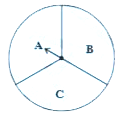
When you spin the wheel shown, What are ...

When you spin the wheel shown, What are the possible outcomes?
(Out comes here means the possible sector where the pointer stops)

Promotional Banner

Topper's Solved these Questions

  • PROBABILITY

    NCERT KANNAD|Exercise THINK, DISCUSS AND WRITE|3 Videos
  • PROBABILITY

    NCERT KANNAD|Exercise DO THIS|3 Videos
  • PROBABILITY

    NCERT KANNAD|Exercise EXERCISE - 14.1|8 Videos
  • POLYNOMIALS AND FACTORISATION

    NCERT KANNAD|Exercise TRY THESE|5 Videos
  • PROOFS IN MATHEMATICS

    NCERT KANNAD|Exercise EXERCISE - 15.4|15 Videos

Similar Questions

Explore conceptually related problems

When you roll a die, What are the six possible outcomes?

If you try to start a scooter , What are the possible outcomes?

A die has six faces numbered from 1 to 6. It is rolled and the number on the top face is noted. When this is treated as a random trial. a) What are the possible outcomes ? b)Are they equally likely? Why? c) Find the probability of a composite number turning up on the top face.

A spinner has four colours as shown in the figure. When we spin it once, find a) At which colour, is the pointer more likely to stop? b) At which colour, is the pointer less likely to stop? c) At which colours, is the pointer equally likely to stop? d) What is the chance the pointer will stop on white? e) Is there any colour at which the pointer certainly stops?

If you have a spinning wheel with 3 green sectors, 1 blue sector and 1 red sector,what is the probability of getting a green sector?What is the probability of getting a non-blue sector?

Guniea pig having black colour when crossed with guinea pig having same colour produced 80 offsprings, out of which 60 were black and 20 were whie. Now, find out a] What is the possible genotype of the guinea pigs? b] Which traits is dominant and which traits is recessive? c] What is this cross called as and what is its phenotypic ratio?

Think of this puzzle What do you need to find a chosen number from this square? Four of the clues below are true but do nothing to help in finding the number. Four of the clues are necessary for finding it. Here are eight clues to use: a. The number is greater than 9. b. The number is not a multiple of 10. c. The number is a multiple of 7. d. The number is odd. e. The number is not a multiple of 11. f. The number is less than 200. g. Its ones digit is larger than its tens digit. h. Its tens digit is odd. What is the number? Can you sort out the four clues that help and the four clues that do not help in finding it? First follow the clues and strike off the number which comes out from it. Like - from the first clue we come to know that the number is not from 1 to 9. (strike off numbers from 1 to 9). After completing the puzzle, see which clue is important and which is not?

Some of the most profound statements on the nature of science have come from Albert Einstein, one of the greatest scientists of all time. What do you think did Einstein mean when he said : “The most incomprehensible thing about the world is that it is comprehensible”?