

Home
Class 12
MATHS
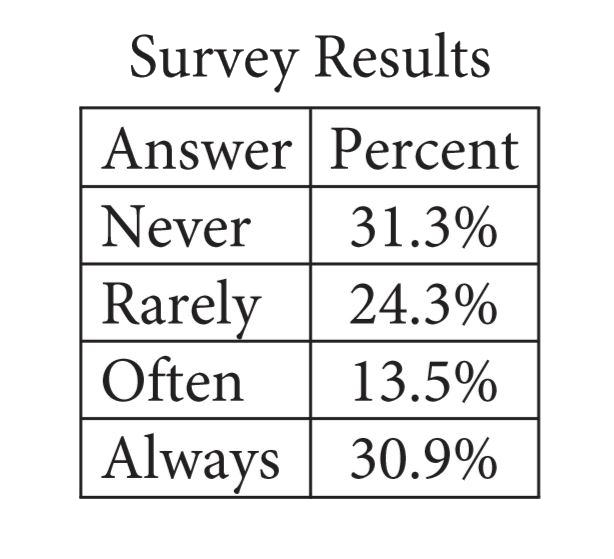
The table above shows the results of a s...


The table above shows the results of a survey in which tablet users were asked how often they would watch video advertisements in order to access streaming content for free. Based on the table, which of the following is closest to the probability that a tablet user answered “Always,” given that the tablet user did not answer “Never”?

Promotional Banner

Similar Questions

Explore conceptually related problems

The graph above shows the result of a survery in which adults were asked to name first prefecnce among various types of climates. Of the adults surveryed a total of 280 answered "Humid" or "other". How many answered "Other" in the survey?

The Harrisburg Recreation Center recently changed its hours to open 1 hour later and close 3 hours later than it had previously. Residents of Harrisburg age 16 or older were given a survey and 560 residents replied. The survey asked each resident his or her student status (high school, college, or nonstudent) and what he or she thought about the change in hour (approve, disapprove, or no opinion). The results are summarized in the table below. Suppose a person will be chosen at random from these 560 residents. Which of the following values is closest to the probability that the person chosen will NOT be a high student and will NOT have replied with no opinion?

The reliability of a COVID PCR test is specified as follows Of people having COVID, 90% of the test detects the disease but 10% goes undetected. Of people free of COVID, 99% of the test is judged COVID negative but 1% are diagnosed as showing COVID positive. From a large population of which only 0.1% have COVID, one person is selected at random, given the COVID PCR test, and the pathologist reports him/her as COVID positive. Based on the above information, answer the following What is the probability of the ‘person to be tested as COVID positive’ given that ‘he is actually not having COVID’?

The reliability of a COVID PCR test is specified as follows Of people having COVID, 90% of the test detects the disease but 10% goes undetected. Of people free of COVID, 99% of the test is judged COVID negative but 1% are diagnosed as showing COVID positive. From a large population of which only 0.1% have COVID, one person is selected at random, given the COVID PCR test, and the pathologist reports him/her as COVID positive. Based on the above information, answer the following What is the probability that the ‘person is actually having COVID given that ‘he is tested as COVID positive’?

The reliability of a COVID PCR test is specified as follows Of people having COVID, 90% of the test detects the disease but 10% goes undetected. Of people free of COVID, 99% of the test is judged COVID negative but 1% are diagnosed as showing COVID positive. From a large population of which only 0.1% have COVID, one person is selected at random, given the COVID PCR test, and the pathologist reports him/her as COVID positive. Based on the above information, answer the following What is the probability that the ‘person selected will be diagnosed as COVID positive’?

In the modern periodic table, the elements are arranged in the increasing order of their atomic number. This arrangement is based on the modern periodic law, which states that the properties of elements are a periodic function of their atomic numbers. In the modern periodic table, each column is called a group and each row is called a period. Elements within the same group show similarity and gradation in properties. This is due to the same number of electroms in the outermost shell . Based on the above paragraph, answer the following question: What is the number of valence electrons in an element of group 1 and group 18 respectively?