

Home
Class 12
MATHS
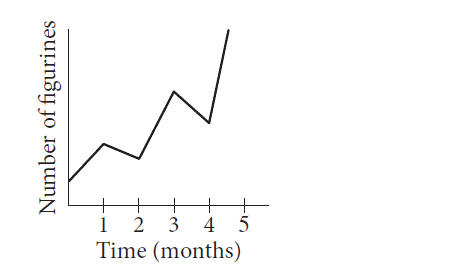
Tracy collects, sells, and trades figuri...

Tracy collects, sells, and trades figurines, and she tracks the number of figurines in her collection on the graph below.

On what interval did the number of figurines decrease the fastest?

Promotional Banner

Similar Questions

Explore conceptually related problems

Read the bar graph given below and answer the following questions: In which year did the number of students decrease as compared to previous year?

By increasing the cost of entry ticket to a fair in the ratio 10 : 13 , the number of visitors to the fair has decreased in the ratio 6 : 5 . In what ratio has the total collection increased or decreased ?

Jutiet is painting figuriness of superheroes as part of an art project. She paints 3 figuriness per day for the first 5 days of the project. Realizing that she needs to finish sooner, Jutiet increase her workload to paint 5 figurines per day for the remaining duration of the project. She plans to sell 80% of the figurines. What is the least number of days Jutiet needs to paint figurines for the rest of the project in order to sell at least 112 figurines?

Julia went to Cancun during summer vaction. She recorded the number of pesos she spent on the first five days of her trip in the table below. How many pesos did she spend on the sixth day to make the mean expenditure per day (for six days) 220? {:("July",1,2,3,4,5,6),("Pesos spent",250,100,150,100,140,?):}

(Manufacturing problem) A manufacturer has three machines I, II and III installed in his factory. Machines I and II are capable of being operated for at most 12 hours whereas machine HI must be operated for atleast 5 hours a day. She produces only two items M and N each requiring the use of all the three machines. The number of hours required for producing 1 unit of each of M and N on the three machines are given m the following table: She makes a profit of Rs 600 and Rs 400 on items M and N respectively. How many of each item should she produce so as to maximise her profit assuming that she can sell all the items that she produced? What will be the maximum profit?

(Manufacturing problem) A manufacturer has three machines I, II and III installed in his factory. Machines I and II are capable of being operated for at most 12 hours whereas machine III must be operated for atleast 5 hours a day. She produces only two items M and N each requiring the use of all the three machines. The number of hours required for producing 1 unit of each of M and N on the three machines are given in the following table : She makes a profit of Rs. 600 and Rs. 400 on items M and N respectively. How many of each should she produce so as to maximise her profit assuming that she can sell all the items that she produced? What will be the maximum profit ?

Himadri has a collection of 625 Indian postal stamps and 325 International postal stamps She wants to display them in identical groups of Indian and International stamps with no stamps left out. What is the greatest number of groups Himadri can display the stamps?