Home
Class 12
MATHS
Let A,B, and C be three sets such that ...

Let A,B, and C be three sets such that
`A={(x,y)|(x)/(cos theta)=(y)/(sintheta)=5,"where" 'theta'"is parameter"}`
`B= {(x,y)|(x-3)/(cos phi)=(y-4)/(sin phi)=r}`
`C= { (x,y)|(x-3)^(2)+(y-4)^(2)leR^(2)}`
If `phi` is fixed and r varies and `(A cap B) =1`, then `sec phi` is equal to

A

`(5)/(4)`

B

`(-5)/(4)`

C

`(5)/(3)`

D

`(-5)/(3)`

Text Solution

Verified by Experts

The correct Answer is:
2

`A= { (x,y)}(x)/(cos theta) =(y)/(sin theta) =5, ` where `theta ` is parameter `}`
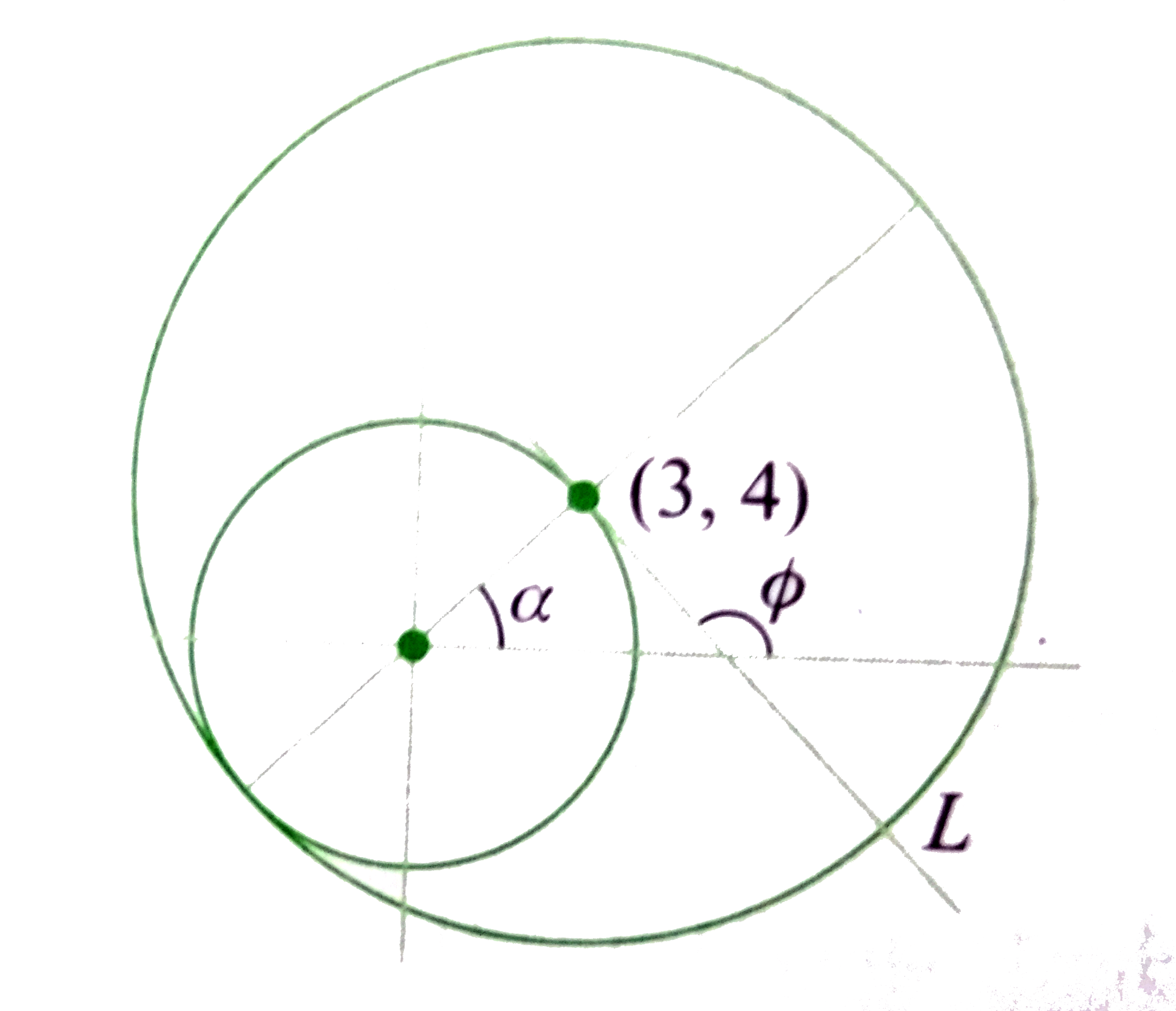
A is set of points which lie of the circle `C_(1) : x^(2)+y^(2) =25`
`B = { (x,y)|(x-3)/(cos phi)=(y-4)/(sin phi) =r}`
If` phi` varies and r is fixed, then B is the set of all points which lie on a circle `C_(2) : (x-3)^(2) +(y-4)^(2) =r^(2)`
And if `phi` is fixed and r varies, then B is the set of all points which lie on the straight line `L : y-4= tan theta ( x-3)`.

Now, if `A cap C =A`
Both circle `C_(1)` and `C_(2)` must touch each other internally.
So, R must be 10.
If `phi` is fixed and r varies and `n ( A cap B) = 1`, circle `C_(1)` touches line L.
`phi =90^(@) + alpha`
`:. sec phi = sec ( 90^(@) +alpha)= - cosect alpha = - (5)/(4)`
Promotional Banner

Topper's Solved these Questions

Similar Questions

Explore conceptually related problems

If y sin phi=x sin(2 theta+phi) show that (x+y)cot(theta+phi)=(y-x)cot theta

If 2cos theta=x+(1)/(x) and 2cos phi=y+(1)/(y) then

If y(dy)/(dx) = x[(y^(2))/(x^(2)) +(phi((y^(2))/(x^(2))))/(phi'((y^(2))/(x^(2))))], x ge 0, phi gt 0 , y(1) = -1, then phi((y^(2))/(4)) is equal to :

(sin theta-sin phi)^(2)+(cos theta-cos phi)^(2)=4sin^(2)(theta-phi)/(2)

Let (dy)/(dx) = (y phi'(x)-y^(2))/(phi(x)) , where phi(x) is a function satisfies phi(1) = 1, phi(4) = 1296 . If y(1) = 1 then y(4) is equal to__________

If tan theta* tan phi = sqrt((x-y)/(x+y)) prove that (x - y cos 2theta)(x - y cos 2phi) = x^(2) – y^(2)

CENGAGE-CIRCLE -Exercise (Comprehension)
  1. Two variable chords AB and BC of a circle x^(2)+y^(2)=a^(2) are such t...

    Text Solution

    |

  2. Give two circles intersecting orthogonally having the length of common...

    Text Solution

    |

  3. Give two circles intersecting orthogonally having the length of common...

    Text Solution

    |

  4. Give two circles intersecting orthogonally having the length of common...

    Text Solution

    |

  5. In the given figure, there are two circles with centers A and B. The c...

    Text Solution

    |

  6. In the given figure, there are two circles with centers A and B. The c...

    Text Solution

    |

  7. In the given figure, there are two circles with centers A and B. The c...

    Text Solution

    |

  8. Let each of the circles S(1)-=x^(2)+y^(2)+4y-1=0 S(1)-= x^(2)+y^(2...

    Text Solution

    |

  9. Let each of the circles S(1)-=x^(2)+y^(2)+4y-1=0 S(1)-= x^(2)+y^(2...

    Text Solution

    |

  10. Let each of the circles S(1)-=x^(2)+y^(2)+4y-1=0 S(1)-= x^(2)+y^(2...

    Text Solution

    |

  11. The line x + 2y = a intersects the circle x^2 + y^2 = 4 at two distinc...

    Text Solution

    |

  12. The line x + 2y = a intersects the circle x^2 + y^2 = 4 at two distinc...

    Text Solution

    |

  13. Let A,B, and C be three sets such that A={(x,y)|(x)/(cos theta)=(y)/...

    Text Solution

    |

  14. Let A,B, and C be three sets such that A={(x,y)|(x)/(cos theta)=(y)/...

    Text Solution

    |

  15. Consider the family of circles x^(2)+y^(2)-2x-2ay-8=0 passing through...

    Text Solution

    |

  16. Show that equation x^2+y^2-2ay-8=0 represents, for different values o...

    Text Solution

    |

  17. Consider the family of circles x^(2)+y^(2)-2x-2ay-8=0 passing through...

    Text Solution

    |

  18. A circle C of radius 1 is inscribed in an equilateral triangle PQR. Th...

    Text Solution

    |

  19. A circle C of radius 1 is inscribed in an equilateral triangle PQR. Th...

    Text Solution

    |

  20. A circle C of radius 1 is inscribed in an equilateral triangle PQR. Th...

    Text Solution

    |

