

Home
Class 11
PHYSICS
A particle of mass 0.1kg is launched at ...

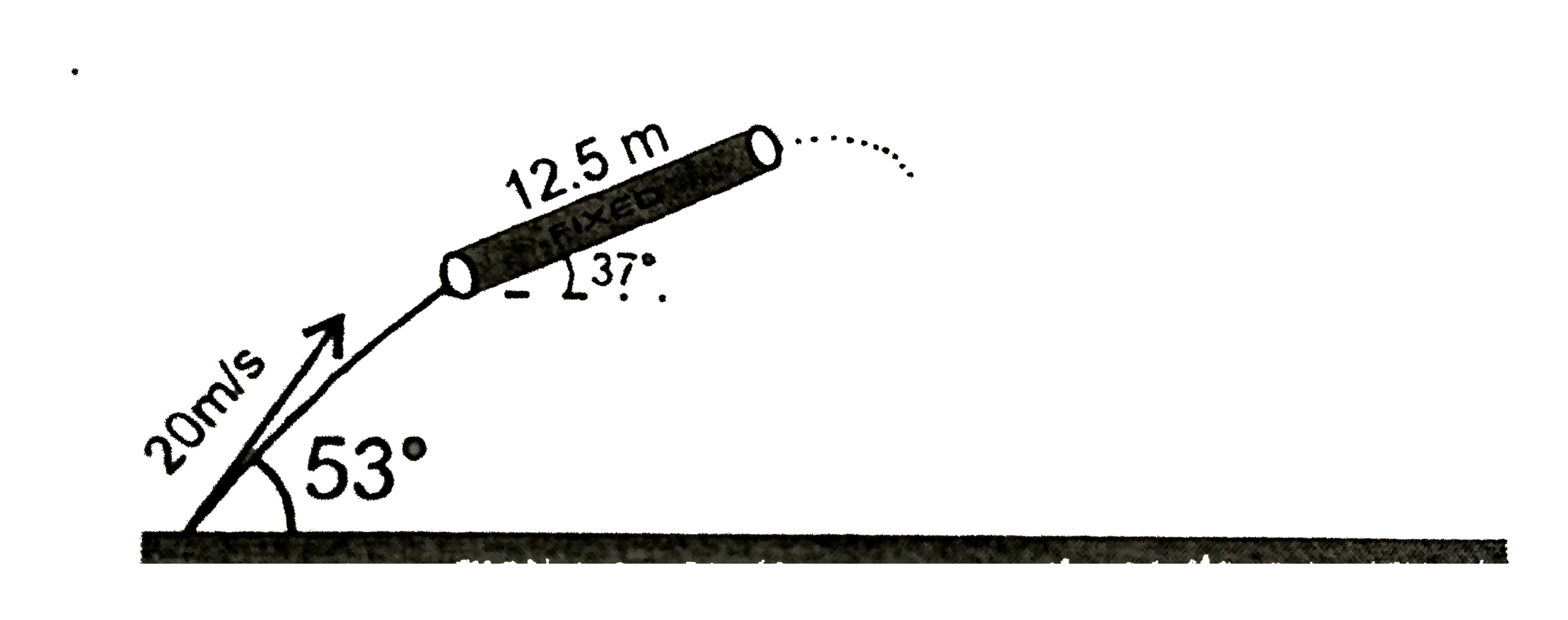
A particle of mass `0.1kg` is launched at an angle of `53^(@)` with the horizontal . The particle enters a fixed rough hollow tube whose length is slightly less than `12.5m` and which is inclined at an angle of `37^(@)` with the horizontal as shown in figure. It is known that the velocity of ball when it enters the tube is parallel to the axis of the tube. The coefficient of friction betweent the particle and tube inside the tube is `mu=(3)/(8)[` Take `g=10m//g^(2)]`

The velocity of the particle as it enters the tube is `:`

Promotional Banner

Similar Questions

Explore conceptually related problems

A particle of mass 0.1kg is launched at an angle of 53^(@) with the horizontal . The particle enters a fixed rough hollow tube whose length is slightly less than 12.5m and which is inclined at an angle of 37^(@) with the horizontal as shown in figure. It is known that the velocity of ball when it enters the tube is parallel to the axis of the tube. The coefficient of friction betweent the particle and tube inside the tube is mu=(3)/(8)[ Take g=10m//g^(2)] The kinetic energy of the particle when it comes out of the tube is approximately equal to :

A particle of mass 0.1kg is launched at an angle of 53^(@) with the horizontal . The particle enters a fixed rough hollow tube whose length is slightly less than 12.5m and which is inclined at an angle of 37^(@) with the horizontal as shown in figure. It is known that the velocity of ball when it enters the tube is parallel to the axis of the tube. The coefficient of friction betweent the particle and tube inside the tube is mu=(3)/(8)[ Take g=10m//g^(2)] The kinetic energy of the particle when it comes out of the tube is approximately equal to :

A particle of mass 0.1kg is launched at an angle of 53^(@) with the horizontal . The particle enters a fixed rough hollow tube whose length is slightly less than 12.5m and which is inclined at an angle of 37^(@) with the horizontal as shown in figure. It is known that the velocity of ball when it enters the tube is parallel to the axis of the tube. The coefficient of friction betweent the particle and tube inside the tube is mu=(3)/(8)[ Take g=10m//g^(2)] The distance from the point of projection where the particle will land on the horizontal plane after coming out from the tube is approximately equal to :

A particle of mass 0.1kg is launched at an angle of 53^(@) with the horizontal . The particle enters a fixed rough hollow tube whose length is slightly less than 12.5m and which is inclined at an angle of 37^(@) with the horizontal as shown in figure. It is known that the velocity of ball when it enters the tube is parallel to the axis of the tube. The coefficient of friction betweent the particle and tube inside the tube is mu=(3)/(8)[ Take g=10m//g^(2)] The distance from the point of projection where the particle will land on the horizontal plane after coming out from the tube is approximately equal to :

Calculate the length of mercury column in a barometer tube which is inclined at an angle of 45^(@) with horizontal direction if the atmospheric pressure is 75 cm of mercury.

An incompressible liquid flows through a horizontal tube LMN as shown in the figure. Then the velocity V of the liquid throught he tube N is:

What will be the length of mercury column in a barometer tube, when the atmospheric pressure is 76 cm of mercury and the tube is inclined at an angle of 30 ^(@) with the horizontal direction ?

What will be the length of mercury column in a barometer tube when the atmosperic pressure is 75 cm of mercury and the tube is inclined at an angle of 60^@ with the horizontal direction?

A particle is thrown at time t=0 with a velocity of 10 m/s at an angle of 60^(@) with the horizontal from a point on an incline plane, making an angle of 30^(@) with the horizontal. The time when the velocity of the projectile becomes parallel to the incline is :