

Home
Class 12
PHYSICS
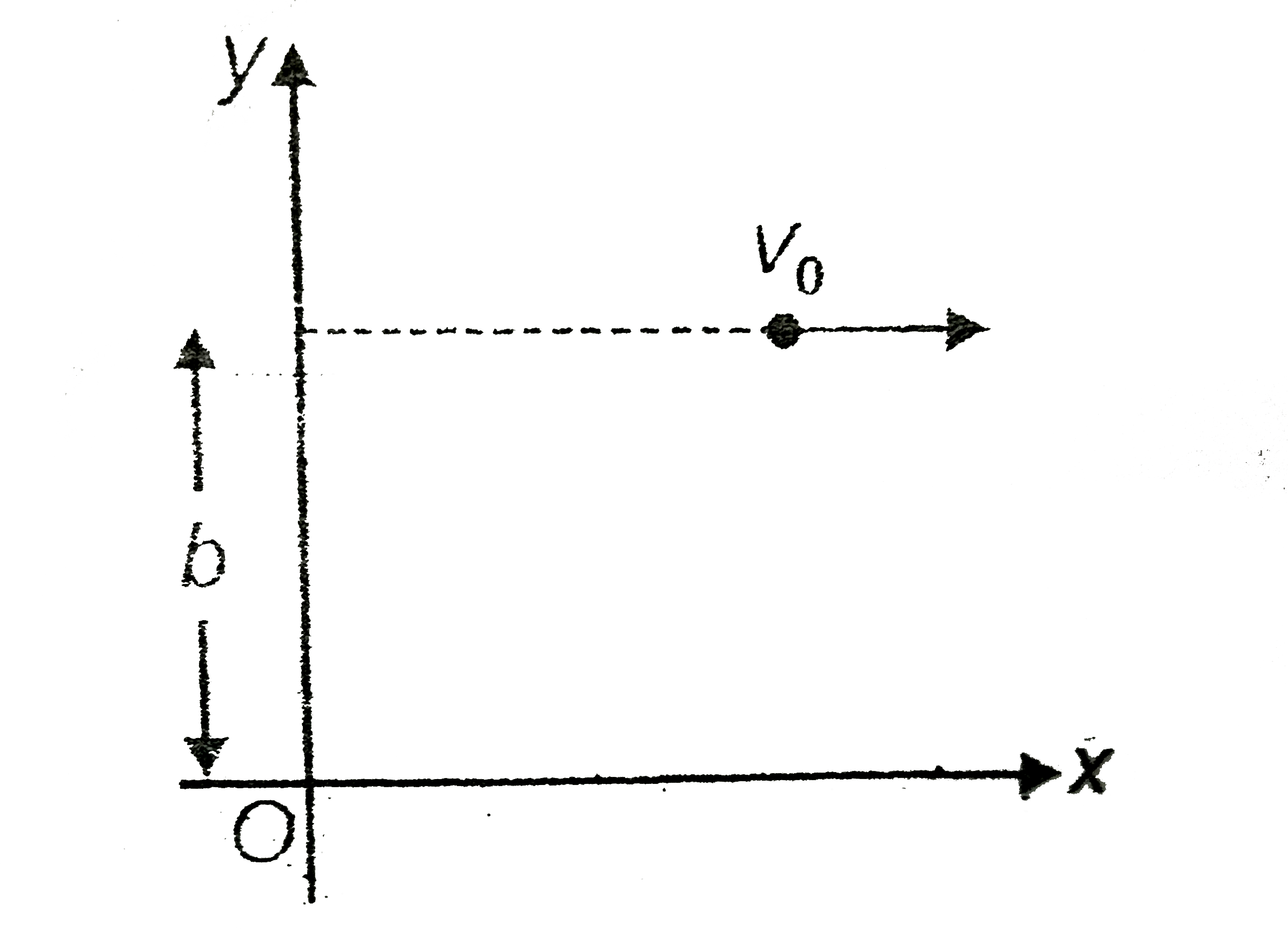
A particle of mass m is moving with cons...

A particle of mass `m` is moving with constant velocity `v_(0)` along the line `y=b`. At time `t=0` it was at the point `(0,b)`. At time `t=(b)/(v_(0))`, the

Promotional Banner

Similar Questions

Explore conceptually related problems

A particle of mass m is travelling with a constant velocity v=v_(0)hati along the line y=b,z=0 . Let dA be the area swept out by the position vector from origin to the particle in time dt and L the magnitude of angular momentum of particle about origin at any time t. Then

A particle of mass m is travelling with a constant velocity v=v_(0)hati along the line y=b,z=0 . Let dA be the area swept out by the position vector from origin to the particle in time dt and L the magnitude of angular momentum of particle about origin at any time t. Then

Two particles A and B are moving with constant velocities V_(1)=hatj and v_(2)=2hati respectively in XY plane. At time t=0, the particle A is at co-ordinates (0,0) and B is at (-4,0). The angular velocities of B with respect to A at t=2s is (all physical quantities are in SI units)

Two particles A and B are moving with constant velocities V_(1)=hatj and v_(2)=2hati respectively in XY plane. At time t=0, the particle A is at co-ordinates (0,0) and B is at (-4,0). The angular velocities of B with respect to A at t=2s is (all physical quantities are in SI units)

A particle move with a velocity v=alpha t^(3) along a straight line.The average velocity in time interval t=0 to t=T is

A meter stick AB is lying on a horizontal table. Its end A is pulled up so as to move it with a constant velocity V_(A) = 4ms^(–1) along a vertical line. End B slides along the floor. (a) After how much time (t_(0)) speed (V_(B)) of end B becomes equal to the speed (V_(A)) of end A ? (b) Find distance travelled by the end B in time t_(0) .

A particle of mass m is moving along the line y-b with constant acceleration a. The areal velocity of the position vector of the particle at time t is (u=0)

A particle moves with an initial velocity v_(0) and retardation alpha v , where v is the velocity at any time t.