Home
Class 11
PHYSICS
Given below are observations on molar sp...

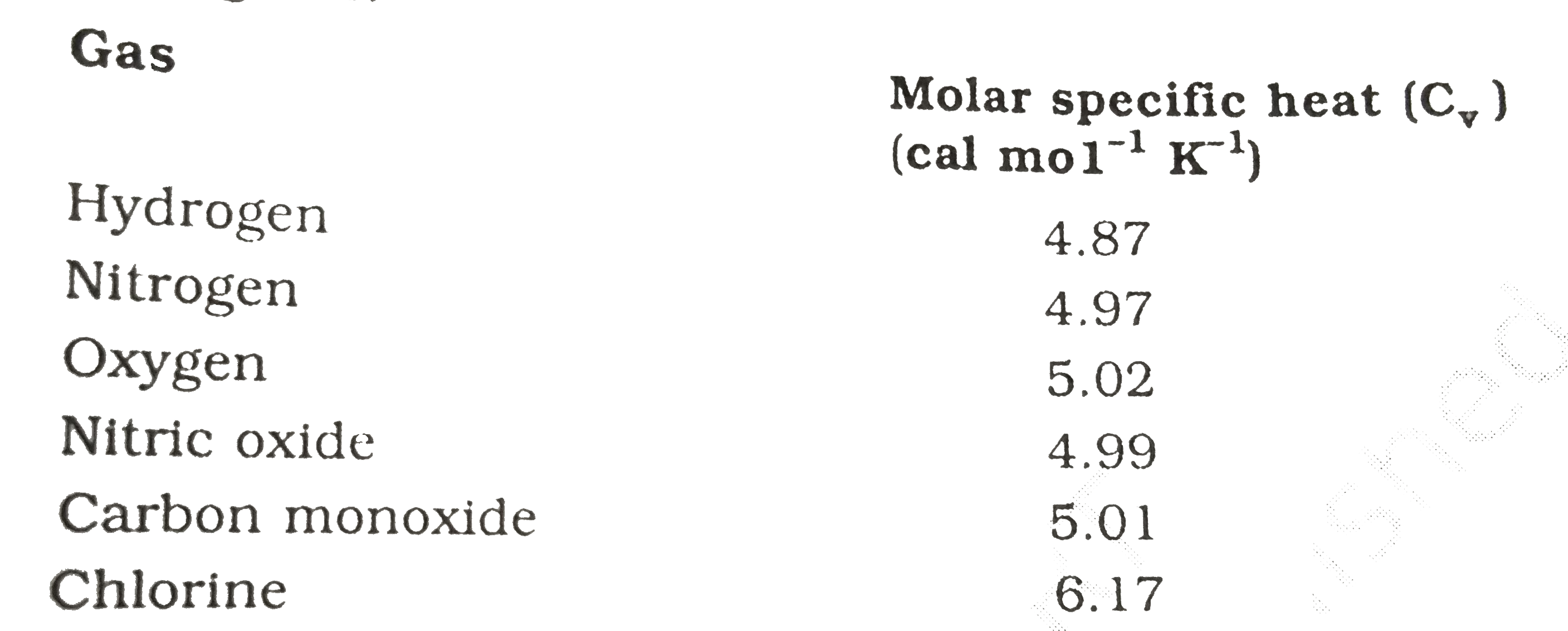
Given below are observations on molar specific heats at room temperature of some common gases

The measured molar specific heats of these gases are markedly different from those for monoatomic gases. Typically, molar specific heat of a monoatomic gas is 2.92 cal/mol K. Explain this difference. What can you infer from the somewhat larger (than the rest) value for chlorine ?

Text Solution

Verified by Experts

The gases are diatomic, and have other degrees of freedom fic, have other modes of motion) possible besides the translational degrees of freedom. To raise the temperature of the gas by a certain amount, heat is to be supplied to increase the average energy of all the modes Consequently, molar specific heat of diatomic gases is more than that of monatomie gases. It can be shown that if only rotational modes of motion are considered, the molar specific heat of diatomic gases is nearly (5/2) R which agrees with the observations for all the gases listed in the table, except chlorine. The higher value of molar specific heat of chlorine indicates that besides rotational modes, vibrational modes are also present in chlorine at room temperature.
Promotional Banner

Topper's Solved these Questions

  • THERMAL PROPERTIME OF MATTER

    NCERT TAMIL|Exercise EXERCISES|31 Videos
  • SYSTEMS OF PARTICLES AND ROTATIONAL MOTION

    NCERT TAMIL|Exercise EXERCISES (TRUE OR FALSE)|5 Videos
  • THERMODYNAMICS

    NCERT TAMIL|Exercise EXERCISES|10 Videos

Similar Questions

Explore conceptually related problems

One mole of a gas occupies 22.4 lit at N.T.P Calculate the difference between two molar specific heates of the gas . J = 4200 J / K cal :

Water is a universal slvent. But alcohol also dissolves most of the substances soluble in water and also many more. Boiling point of water is 100^(@)C and that of alcohol is 80^(@)C. The specific heat of water is much higher than the specific heat of alcohol. (a) List out three possible differences if instead of water as teh liquid in our body we had alcohol. (b) What value can you derive from this special property of water and its innumerable uses in sustaining life on earth ?

The mass of a helium atom is 6.66× 10^-27 kg. Compute the specific heat at constant volume for helium gas (in J/kg.K) from the molar heat capacity at constant volume.

The molar specific heats of an ideal gas at a constant pressure & volume are denoted by C_(P ) & C_(v ) if r = (C_(p))/(C_(v )) & R the universal gases constant then C_(v ) is equal

An experiment is performed to measure the molar heat capacity of a gas at constant pressure using Regnault's method. The gas is initially contained in a cubical reservoir of size 40 cm xx 40 cm xx 40 cm xx at 600 kPa at 27^0C . A part of the gas is brought out, heated to 100^0C and is passed through a calorimeter at constant pressure. The water equivalent of the calorimeter and its contents increases from 20^0C to 30^0C during the experiment and the pressure in the reservoir decresases to 525 kPa . Specific heat capacity of water = 4200 J kg^(-1) K^(1). Calculate the molar heat capacity Cp from these data.

NCERT TAMIL-THERMAL PROPERTIME OF MATTER-EXERCISES
  1. A brass wire 1.8 m long at 27^(@)C is held taut with little tension be...

    Text Solution

    |

  2. A brass rod of length 50 cm and diameter 3.0 mm is joined to a steel r...

    Text Solution

    |

  3. The coefficient of volume expansion of glycerine is 49 xx 10^(-5)//^(@...

    Text Solution

    |

  4. A 10 kW drilling machine is used to drill a bore in a small aluminium ...

    Text Solution

    |

  5. A copper block of mass 2.5 kg is heated in a furnace to a temperature ...

    Text Solution

    |

  6. In an experiment on the specific heat of a metal a 0.20 kg block of th...

    Text Solution

    |

  7. Given below are observations on molar specific heats at room temperatu...

    Text Solution

    |

  8. A child running a temperature of 101^F is given and antipyrin (i.e. a ...

    Text Solution

    |

  9. A thermocole cubical icebox of side 30 cm has a thickness of 5.0 cm if...

    Text Solution

    |

  10. A brass boiler has a base area of 0.15m^2 and thickness 1 cm. It boils...

    Text Solution

    |

  11. Explain why : (a) A body with large reflectivity is a poor emitter. (...

    Text Solution

    |

  12. A body cools from 80^(@)C to 50^(@)C in 5 minutes. Calculate the time ...

    Text Solution

    |

  13. Answer the following question beased on tbhe P-T phase diagram of carb...

    Text Solution

    |

  14. Answer the following question beased on tbhe P-T phase diagram of carb...

    Text Solution

    |

  15. Answer the following questions based on the p-T phase diagram of carbo...

    Text Solution

    |

  16. Answer the following questions based on the p-T phase diagram of carbo...

    Text Solution

    |

  17. Answer the following questions based on the P – T phase diagram of CO(...

    Text Solution

    |

  18. Answer the following questions based on the P – T phase diagram of CO(...

    Text Solution

    |

  19. Answer the following questions based on the P – T phase diagram of CO(...

    Text Solution

    |

  20. Answer the following questions based on the P – T phase diagram of CO(...

    Text Solution

    |
