

Home
Class 11
PHYSICS
A thermodynamic system is taken from an ...

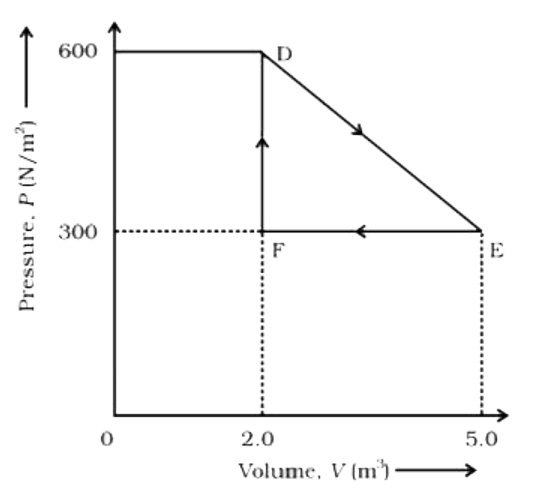
A thermodynamic system is taken from an original state to an intermediate state by the linear process shown in Fig. (12.13)

Its volume is then reduced to the original value from E to F by an isobaric process. Calculate the total work done by the gas from D to E to F

Promotional Banner

Topper's Solved these Questions

  • THERMAL PROPERTIME OF MATTER

    NCERT TAMIL|Exercise EXERCISES|31 Videos
  • UNITS AND MEASUREMENT

    NCERT TAMIL|Exercise EXERCISE (ADDITIONAL EXERCISE)|9 Videos

Similar Questions

Explore conceptually related problems

shows three paths through which a gas can be taken from the state A to the state B. calculate the work done by the gas in each of the three paths.

An ideal gas goes from the state i to the state int as shown in .the work done by the gas during the process

1 liter of an ideal gas (gamma =1.5) at 300k is suddenly compressed to half its original volume. (a) Find the ratio of the final pressure to the initial pressure. (b) If the original pressure is 100 kpa , find the work done by the gas in the process. (c) What is the change in internal energy? (d) What is the final temperature? (e) the gas is now colled to 300k keeping its pressure constant. Calculate the work done during the process . (f) The gas is now expanded iasothermally to achive its original volume of 1 liters. Calculate the work done by the gas .(g) Calculate the total work done in the cycle.

An ideal gas is taken from an initial state i to a final state f in such a way that the ratio of the pressure to the absolute temperature remains constant. What will be the work done by the gas ?

calculate the work done by a gas as it is taken from the state a to b, b to c and c to a as shown in

Consider the cyclic process ABCA, shown in fig, performed on a sample of 2.0 mol if an ideal gas. A total of 1200 J if heat is withdrawn from the sample in the process. Find the work done by the gas during the part BC.

A thermodynamic system is taken through the cycle abcda. (a) calculate the work done by the gas during the parts ab, bc, cd and da. (b) find the total heat rejected by the gas during the process.

A gas is taken along the path AB as shown in fig, if 70 cal of heat is extracted from the gas in the process, calculate the change in the internal energy of the system.

From an equilibrium state A to another equilibrium state A to another equilibrium state B an amount of work equal to 30 J is done on the system .if the gas is taken from state A to B iva a process in which the net heat observe by system is 10 cal , how much is the net work done by the system in the later case. [ Take 1 cal = 4.2 J]