

Home
Class 11
PHYSICS
The force between two atoms in a diatomi...

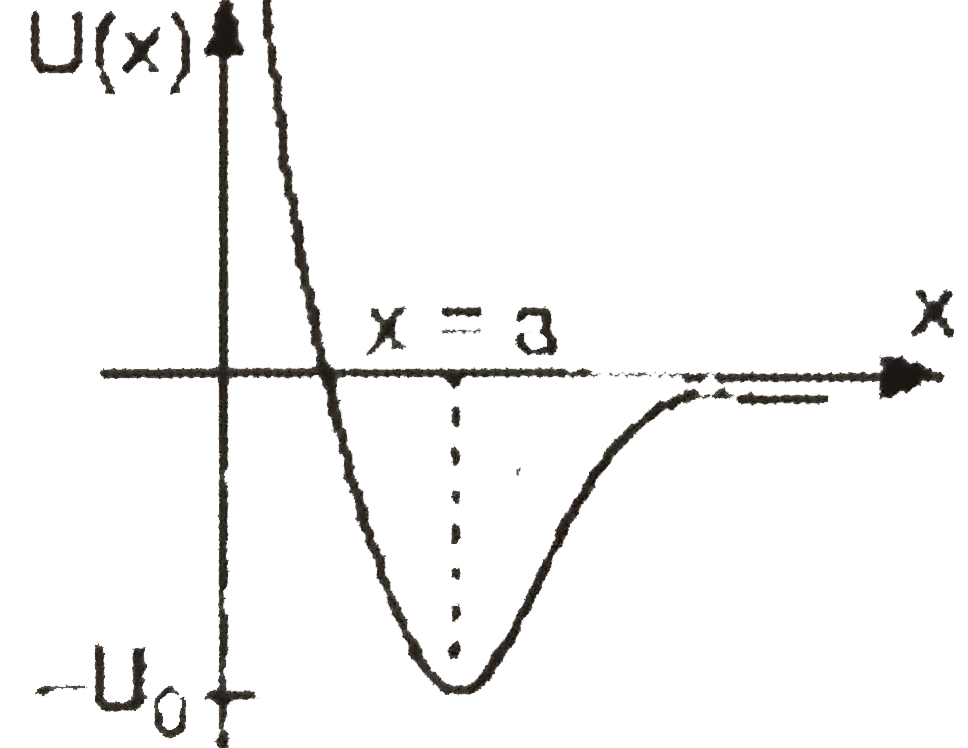
The force between two atoms in a diatomic molecule can be represented approaximately by the potential energy function
`U = U_(0) [((a)/(x))^(12) - 2 ((a)/(x))^(6) ]`
where `U_(0)` and a are constant (a) At what value of x is the potential energy zero ?
(b) Fidn teh force `F_(x)`. (c) At what value of X is the potential energy a minmum ?

Promotional Banner

Similar Questions

Explore conceptually related problems

A particle of mass m is moving in a potential well, for which the potential energy is given by U(x) = U_(0)(1-cosax) where U_(0) and a are positive constants. Then (for the small value of x)

A particle of mass m is moving in a potential well, for which the potential energy is given by U(x) = U_(0)(1-cosax) where U_(0) and a are positive constants. Then (for the small value of x)

The potential energy function for the force between two in a diatomic molecule can approximately be expressed as U(x)=(a)/(x^(12))-(b)/(x^(4)) , where a and b are positive constants, and x is the distance between the atoms. Answer the following question by selecting most appropriate alternative. The graph between potential energy vs x will be

The potential energy function for the force between two in a diatomic molecule can approximately be expressed as U(x)=(a)/(x^(12))-(b)/(x^(4)) , where a and b are positive constants, and x is the distance between the atoms. Answer the following question by selecting most appropriate alternative. The graph between potential energy vs x will be

A particle located in one dimensional potential field has potential energy function U(x)=(a)/(x^(2))-(b)/(x^(3)) , where a and b are positive constants. The position of equilibrium corresponds to x equal to

A particle located in one dimensional potential field has potential energy function U(x)=(a)/(x^(2))-(b)/(x^(3)) , where a and b are positive constants. The position of equilibrium corresponds to x equal to

A particle located in a one-dimensional potential field has its potential energy function as U(x)(a)/(x^4)-(b)/(x^2) , where a and b are positive constants. The position of equilibrium x corresponds to

A particle located in one dimensional potential field has potential energy function U(x)=(a)/(x^(2))-(b)/(x^(3)) , where a and b are positive constants. The position of equilibrium corresponds to x equal to

A particle located in a one-dimensional potential field has its potential energy function as U(x)=(a)/(x^4)-(b)/(x^2) , where a and b are positive constants. The position of equilibrium x corresponds to