

Home
Class 11
PHYSICS
One of the forces acting on a certain pa...

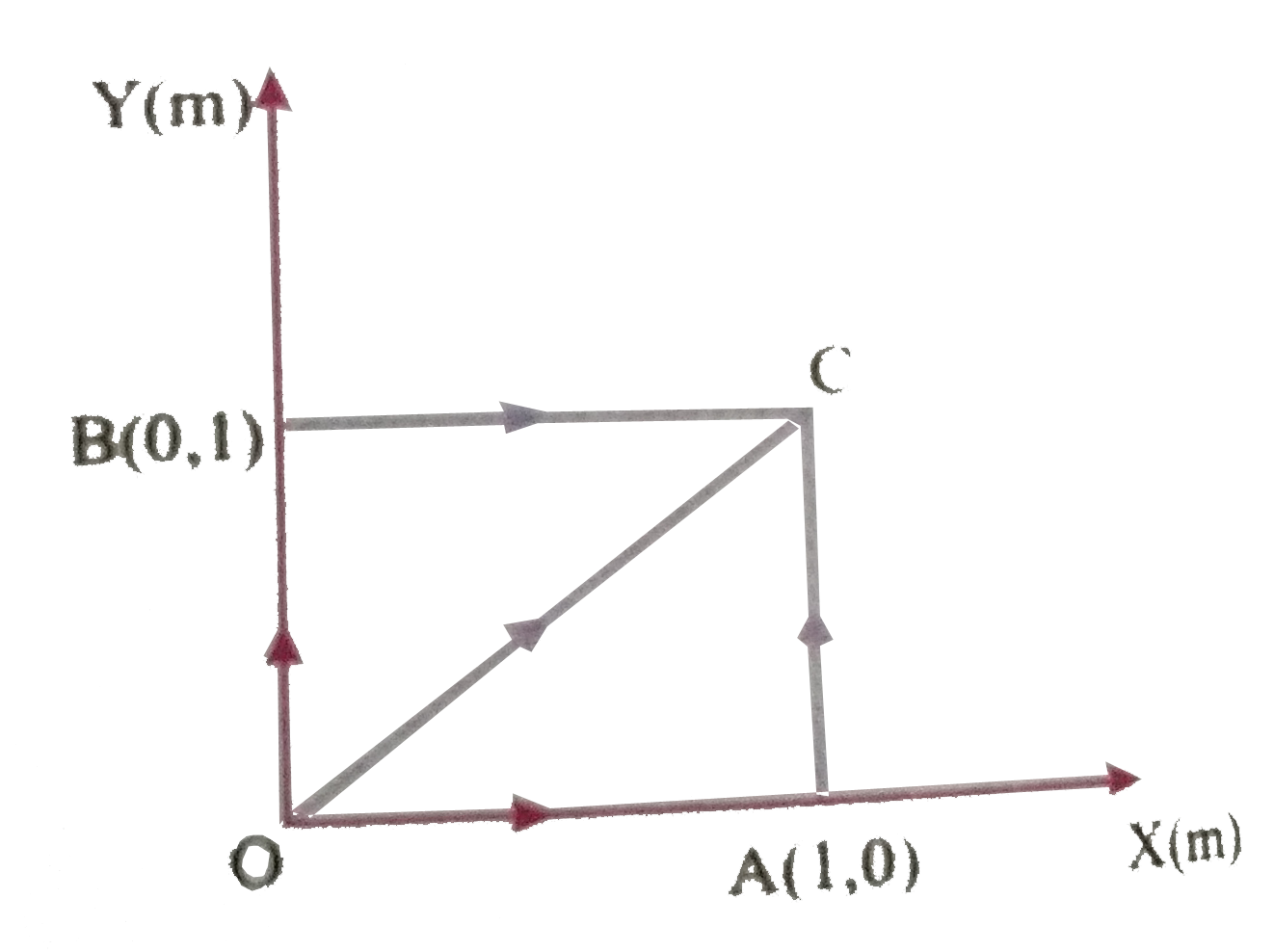
One of the forces acting on a certain particle depends on the particle's position in the `xy`-plane. This force `vec F` expressed in newtons, is given by the expression `vec F = (xy hat i+ xy hat j)` where `x` and `y` are in metres. The particle is moved from `O` to `C` through three different paths :-

The work done by this force on path `OBC` is

Promotional Banner

Similar Questions

Explore conceptually related problems

One of the forces acting on a certain particle depends on the particle's position in the xy -plane. This force vec F expressed in newtons, is given by the expression vec F = (xy hat i+ xy hat j) where x and y are in metres. The particle is moved from O to C through three different paths :- Which of the following can be negative ?

A force acting on a certain particle depends of the particles position in the xy-plane. This force F is given by the expression vec(F) = (xy hat(i) + xy hat(j)) (1 N//m^(2)) where x and y are expressed in metre. If vec(F) is a conservation force ?

If vec(F) = y hat(i) + x hat(j) then find out the work done in moving the particle from position (2,3) to (5,6)

Force acting on a particle moving in the x-y plane is vec F=(y^(2) hat i + x hat j) N, x and y are in metre. As shown in fig. the particle moves from the origin O to point A(6m,6m) . The figure shows three paths, OLA,OMA and OA for the motion of the particle from O to A . Work done for motion along path OA is nearly

A uniform force of (2hat(i)+hat(j)) N acts on a particle of mass 1 kg. The particle displaces from position (3hat(j)+hat(k)) m to (5hat(i)+3hat(j)) m. The work done by the force on the particle is

A particle is moving in xy-plane in circular path with centre at origin.If at an instant the position of particle is given by (1)/(sqrt(2))(hat i+hat j) Then velocity of particle is along

A particle of mass m moves in the xy-plane with velocity of vec v = v_x hat i+ v_y hat j . When its position vector is vec r = x vec i + y vec j , the angular momentum of the particle about the origin is.