

Home
Class 12
PHYSICS
A rod of mass m and length l is hinged a...

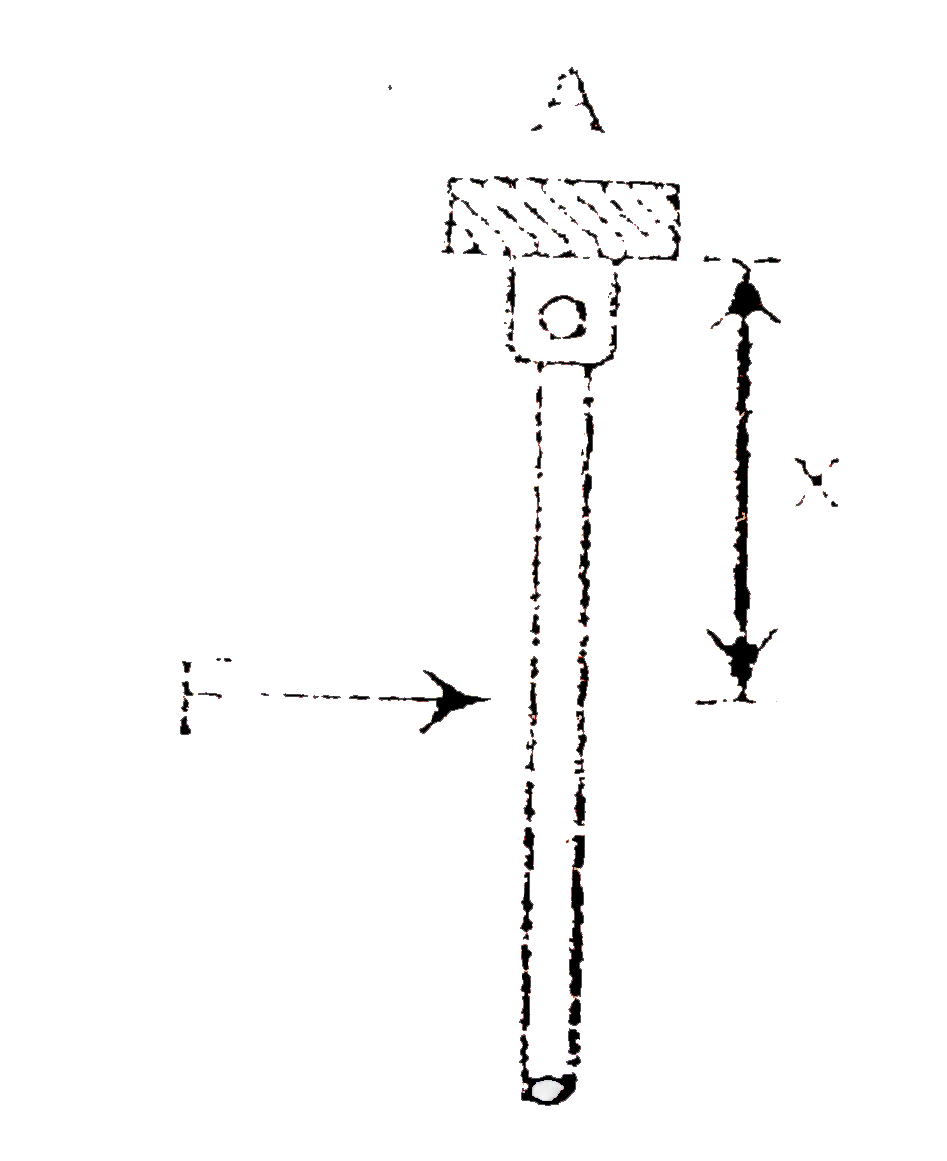
A rod of mass `m` and length `l` is hinged at one of its ends `A` as shown in figure. A force `F` is applied at a distance `x` from `A` . The acceleration of centre of mass varies with `x` as `-`

Promotional Banner

Similar Questions

Explore conceptually related problems

A rod of mass m and length l is hinged at one of its end A as shown in figure. A force F is applied at a distance x from A. The acceleration of centre of mass a varies with x as

A uniform rod of mass M = 2 kg and length L is suspended by two smooth hinges 1 and 2 as shown in Fig. A force F = 4 N is applied downward at a distance L//4 from hinge 2 . Due to the application of force F , hinge 2 breaks. At this instant, applied force F is also removed. The rod starts to rotate downward about hinge 1 . ( g = 10 m//s^(2) ) The acceleration of the end point of the rod of small mass dm at the end point of the rod, when the rod becomes vertical is

A uniform rod of mass M = 2 kg and length L is suspended by two smooth hinges 1 and 2 as shown in Fig. A force F = 4 N is applied downward at a distance L//4 from hinge 2 . Due to the application of force F , hinge 2 breaks. At this instant, applied force F is also removed. The rod starts to rotate downward about hinge 1 . ( g = 10 m//s^(2) ) The reaction at hinge 1 , just after breaking of hinge 2 , is

A uniform rod of mass M = 2 kg and length L is suspended by two smooth hinges 1 and 2 as shown in Fig. A force F = 4 N is applied downward at a distance L//4 from hinge 2 . Due to the application of force F , hinge 2 breaks. At this instant, applied force F is also removed. The rod starts to rotate downward about hinge 1 . ( g = 10 m//s^(2) ) The reaction at hinge 1 , before hinge 2 breaks, is

A uniform rod of mass M = 2 kg and length L is suspended by two smooth hinges 1 and 2 as shown in Fig. A force F = 4 N is applied downward at a distance L//4 from hinge 2 . Due to the application of force F , hinge 2 breaks. At this instant, applied force F is also removed. The rod starts to rotate downward about hinge 1 . ( g = 10 m//s^(2) ) The reaction at hinge 1 , before hinge 2 breaks, is

A uniform disc of mass M and radius R is hinged at its centre C. A force F is applied on the disc as shown. At this instant, the angular acceleration of the disc is