

Home
Class 12
PHYSICS
Two independent harmonic oscillators of ...

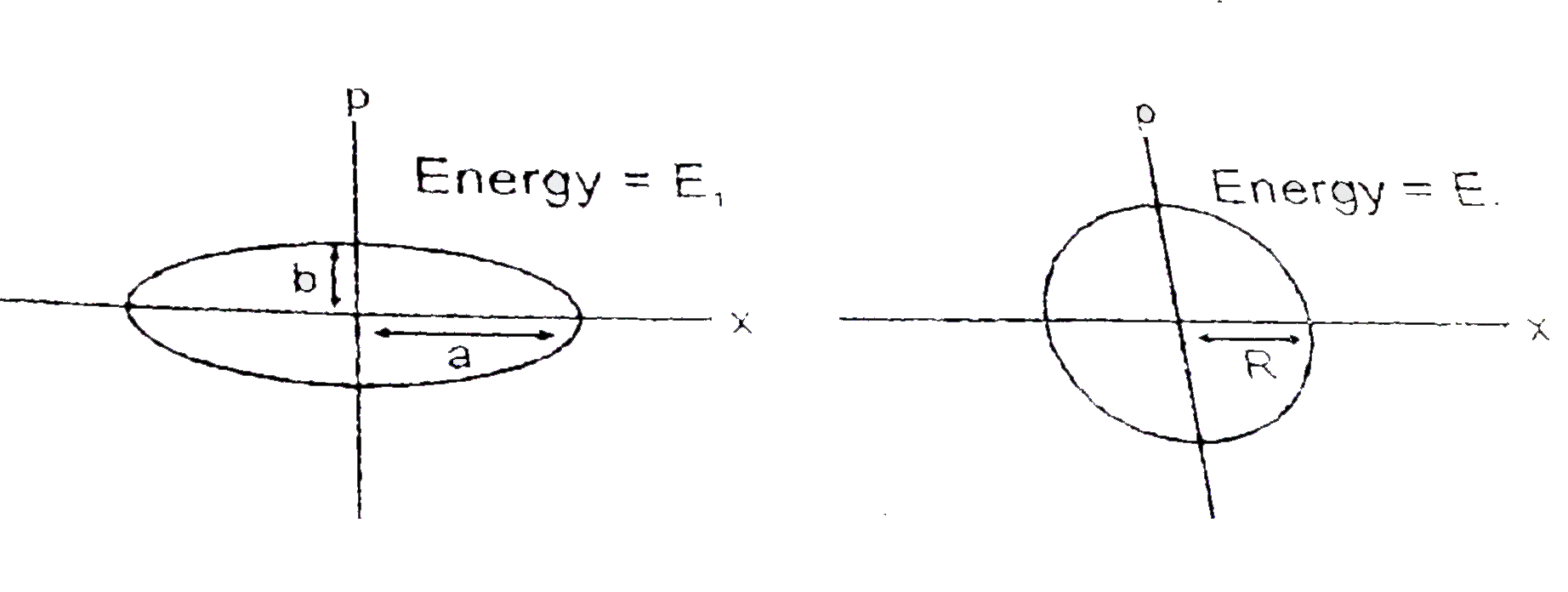
Two independent harmonic oscillators of equal mass are oscillating about the origin with angular frequencies `omega_(1)` and `omega_(2)` and have total energies `E_(1)` and `E_(2)` repsectively. The variations of their momenta `p` with positions `x` are shown in figures. If `(a)/(b) = n^(2)` and `(a)/(R) = n`, then the correc t equation(s) is (are) :

Promotional Banner

Similar Questions

Explore conceptually related problems

Two independent harmonic oscillators of equal mass are oscillating about the origin with angular frequencies (omega_1) and (omega_2) and have total energies (E_1 and E_2), respectively. The variations of their momenta (p) with positions (x) are shown (s) is (are) a/b = n(square) and a/R= n, then the correct eqution...... (##JMA_CHMO_C10_022_Q01##)

Two bodies of different masses m_(1) and m_(2) have equal momenta. Their kinetic energies E_(1) and E_(2) are in the ratio

Two bodies of different masses m_(1) and m_(2) have equal momenta. Their kinetic energies E_(1) and E_(2) are in the ratio

Two bodies of different masses m_(1) and m_(2) have equal momenta. Their kinetic energies E_(1) and E_(2) are in the ratio

Two bodies of different masses m_(1) and m_(2) have equal momenta. Their kinetic energies E_(1) and E_(2) are in the ratio

Two simple harmonic oscillators with amplitudes in the ratio 1:2 are having the same total energy. The ratio of their frequencies is

Two physical pendulums perform small oscillations about the same horizontal axis with frequencies omega_(1) and omega_(2) . Their moments of inertia relative to the given axis are equal to I_(1) and I_(2) respectively. In a state of stable equilibium the pendulums were fastened rigifly together. What will be the frequency of small oscillations of the compound pendulum ?