

Home
Class 12
PHYSICS
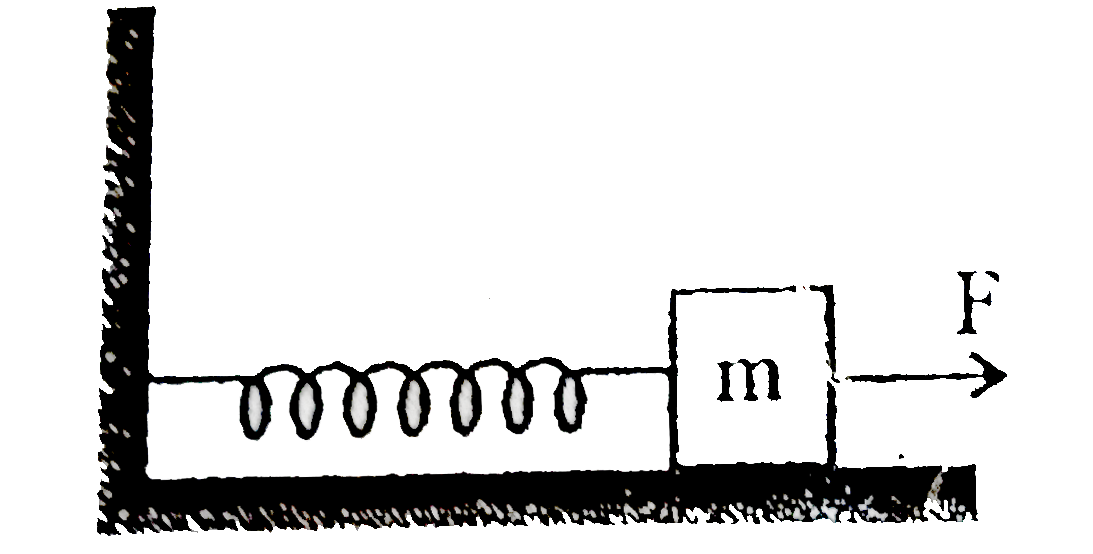
A mass m is attached to a spring. The sp...

A mass `m` is attached to a spring. The spring is stretched to `x` by a force `F` and refeased. After being released, the mass comes to rest at the initial equilibrium position. The coeffiecient of friction, `mu_(k)` , is `:-`

Promotional Banner

Similar Questions

Explore conceptually related problems

A spring with one end attached to a mass and the other to a rigid support is stretched and released.

A spring with one end attached to a mass and the other to a right support is stretched and released

A spring with one end attached to a mass and the other to a rigid suppord is stretched and released.

A spring with one end attached to a mass and the other to a right support is stretched and released

A block of mass m attached in the lower and vertical spring The spring is hung from a calling and force constant value k The mass is released from rest with the spring initially unstreched The maximum value of extension produced in the length of the spring will be

A block of mass M is attached to the lower end of a vertical spring. The spring is hung from a ceiling and has force constant value k. The mass is released from rest with spring initially unstretched. The maximum extension produced in the length of the spring will be............

In Fig 3E.17, the mass m_(2) rests on a rough table. The mass m_(1) is pushed against the spring to which it is not attached Force constant of the spring is k, coefficient of friction is mu_(k) . (a) Find the speed of the blocks after the spring is released and m_(2) has fallen a distance of h . (b) If the spring is attached to the block and it falls a distance h before coming to rest, calculate the coefficient of friction mu_(k) .

A mass m attached to a spring of spring constant k is stretched a distance x_0 from its equilibrium position and released with no initial velocity. The maximum speed attained by mass in its subsequent motion and the time at which this speed would be attained are, respectively.

A mass m attached to a spring of spring constant k is stretched a distance x_0 from its equilibrium position and released with no initial velocity. The maximum speed attained by mass in its subsequent motion and the time at which this speed would be attained are, respectively.

A mass m attached to a spring of spring constant k is stretched a distance x_0 from its equilibrium position and released with no initial velocity. The maximum speed attained by mass in its subsequent motion and the time at which this speed would be attained are, respectively.