

Home
Class 11
PHYSICS
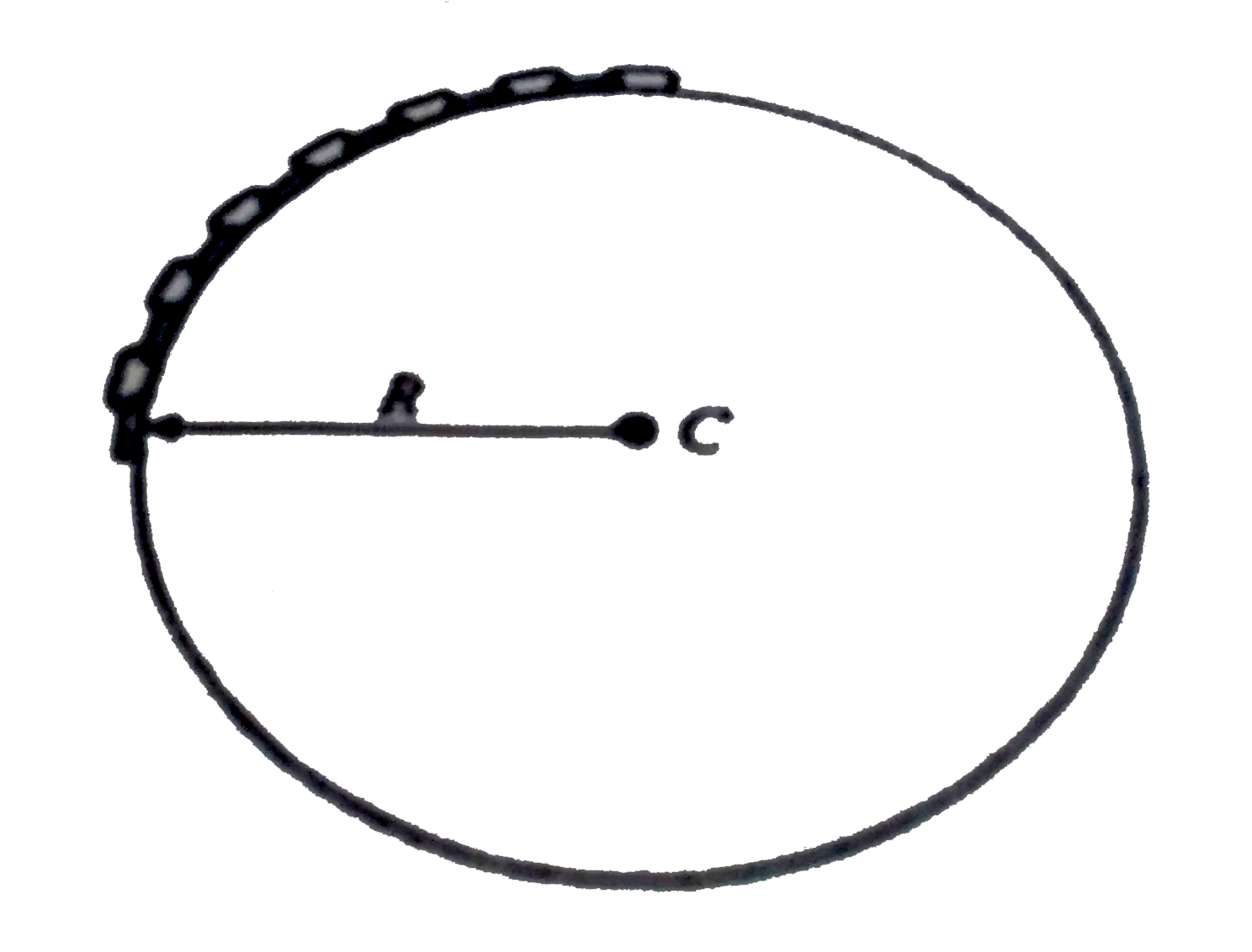
A chain AB of length equal to the quarte...

A chain AB of length equal to the quarter of a circle of radius R is placed on a smooth hemisphere as shown in figure -3.66. When it is released, it starts falling. Find the velocity of the chain when it falls of the end B from the hemisphere.

Promotional Banner

Similar Questions

Explore conceptually related problems

Find out the flux through the curved surface of a hemisphere of radius R if it is placed in a uniform electric field E as shown in figure

Find out the flux through the curved surface of a hemisphere of radius R if it is placed in a uniform electric field E as shown in figure

A smooth chain (AB) of mass (m) rests against a surface in the form of a quarter of circle of radius R. If it is released from rest, the form of a quarter of a circle of radius R. If it is releaded from, the velocity of the chain after it comes over the horizontal part of the surface is .

A smooth chain (AB) of mass (m) rests against a surface in the form of a quarter of circle of radius R. If it is released from rest, the form of a quarter of a circle of radius R. If it is releaded from, the velocity of the chain after it comes over the horizontal part of the surface is .

Two smooth wedges of equal mass m are placed as shown in figure. All surfaces are smooth. Find the velocities of A & B when A hits the ground.

Two smooth wedges of equal mass m are placed as shown in figure. All surfaces are smooth. Find the velocities of A & B when A hits the ground.

A uniform chain of mass m and length l is placed on a smooth table so that one - third length hanges freely as shown in the figure. Now the chain is released, with what velocity chain slips off the table?

AS chain of length l and mass m lies o the surface of a smooth sphere of radius Rgtl with one end tied to the top of the sphere. a.Find the gravitational potential energy of the chain with reference level at the centre of the sphere. B. suppose the chin is released and slides down the sphere. Find the kinetic eneergy of the chain, when it has slid through an angle theta c. find the tangential acceleration (dv)/(dt) of the chain when the chain starts sliding down.