

Home
Class 12
PHYSICS
Two masses m and M are attached to the s...

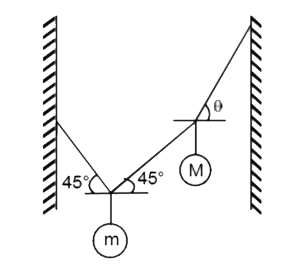
Two masses m and M are attached to the strings as shown in the figure. If the system is in equilibruim, then

Promotional Banner

Similar Questions

Explore conceptually related problems

Two masses m and M are attached to the strings as shown in the figure. If the system is in equilibrium, then

Two masses m and M are attached to the strings as shown in the figure. If the system is in equilibrium, then

Two masses m_(1) and m_(2) are attached with light strings as shown. If the system is in equilibrium, find the value of theta

Two masses m and M are attached with strings as shown. For the system to be in equilibrium we have.

Two masses m and M are attached with strings as shown. For the system to be in equilibrium we have.

Two bodies of masses m and 4 m are attached with string as shown in the figure. The body of mass m hanging from a string of length l is executing oscillations of angular amplitude theta_(0) while the other body is at rest. The minimum coefficient of friction between the mass 4m and the horizontal surface should be

Two bodies of masses m and 4 m are attached with string as shown in the figure. The body of mass m hanging from a string of length l is executing oscillations of angular amplitude theta_(0) while the other body is at rest. The minimum coefficient of friction between the mass 4m and the horizontal surface should be

A long rod ABC of mass "m" and length "L" has two particles of masses "m" and "2m" attached to it as shown in the figure. The system is initially in the horizontal position. The work to be done to keep it vertical with A hinged at the bottom is .

Two objects A and B of masses m_(A) and m_(B) are attached by strings as shown in fig. If they are given upward acceleration then the rato of tension T_(1) : T_(2) is-

Two block each of mass 'm' are attached with two elastic strings as shown in the figure. Masses of strings are negligible in comparison to block of mass 'm' density of material of each string is rho . The whole system is moving vertically upward with an acceleration a = g/2. It is in equilibrium with respect to elevator. Ratio of elongation in rod 1 to that of rod 2 will be