

Home
Class 11
PHYSICS
1 kg and 4 kg blocks lie on a rough hori...

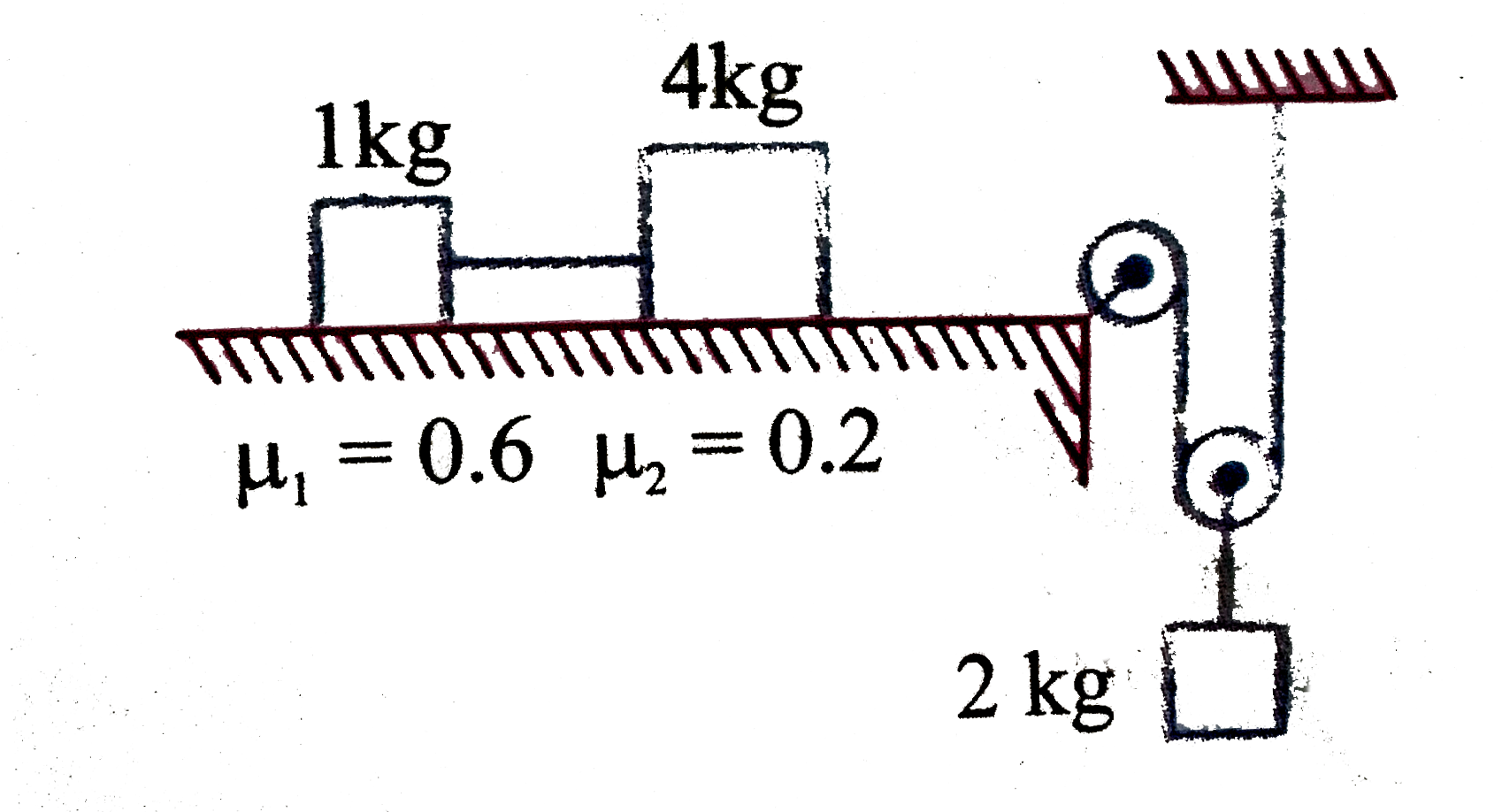
`1 kg` and `4 kg` blocks lie on a rough horizontal surface. The coefficient of friction between `4 kg` blocks and surface is `0.2` while the coefficient of firction between `1 kg` blocks and the surface is `0.6`. All the pulley shown in the figure are massless and frictionless and all strings are massless and frictionless and all strings are massless.

Promotional Banner

Similar Questions

Explore conceptually related problems

A block is kept on a rough horizontal surface as shown. Its mass is 2 kg and coefficient of friction between block and surface (mu)=0.5. A horizontal force F is acting on the block. When

A block is kept on a rough horizontal surface as shown. Its mass is 2 kg and coefficient of friction between block and surface (mu)=0.5. A horizontal force F is acting on the block. When

A block is kept on a rough horizontal surface as shown. Its mass is 2 kg and coefficient of friction between block and surface (mu)=0.5. A horizontal force F is acting on the block. When

Consider the shown arrangement. The coefficient of friction between the two blocks is 0.5 . There is no friction between the 4 kg block and of 12 N is applied on the 2 kg block as shown in the figure, the acceleration of the 4 kg block would be

In the figure, m_(1)=m_(2)=10 kg . The coefficients of friction between A, B and B , surface are 0.2 . Find the maximum value of m_(3) so that no block slips ( All the pullies are ideal and strings are massless).

Acceleration of pulleys and blocks are as shown in the figure. All pulleys & strings are massless & frictionless magnitude of a_(A) and a_(B) are : .

Acceleration of pulleys and blocks are as shown in the figure. All pulleys & strings are massless & frictionless magnitude of a_(A) and a_(B) are : .

In the diagram shown in figure, both pulleys and strings are massless. The acceleration of 2 kg block is

In the diagram shown in figure, both pulleys and strings are massless. The acceleration of 2 kg block is

Block B of mass m_(B) = 0.5 kg rests on block A, with mass m_(A) = 1.5kg which in turn is on a horizontal tabletop (as shown in figure) .The coefficient of kinetic friction between block A and the tabletop is mu_(k) = 0.4 and the coefficient of static friction between block A and blockB is mu_(s) = 0.6 A light string attached block A passes over a frictionless, massless pulley and block C is suspeneded from the other end of the string. What is the largest mass m_(c) (in kg) that block C can have so that block A and B still slide together when the system is relaced from rest?