

Home
Class 11
PHYSICS
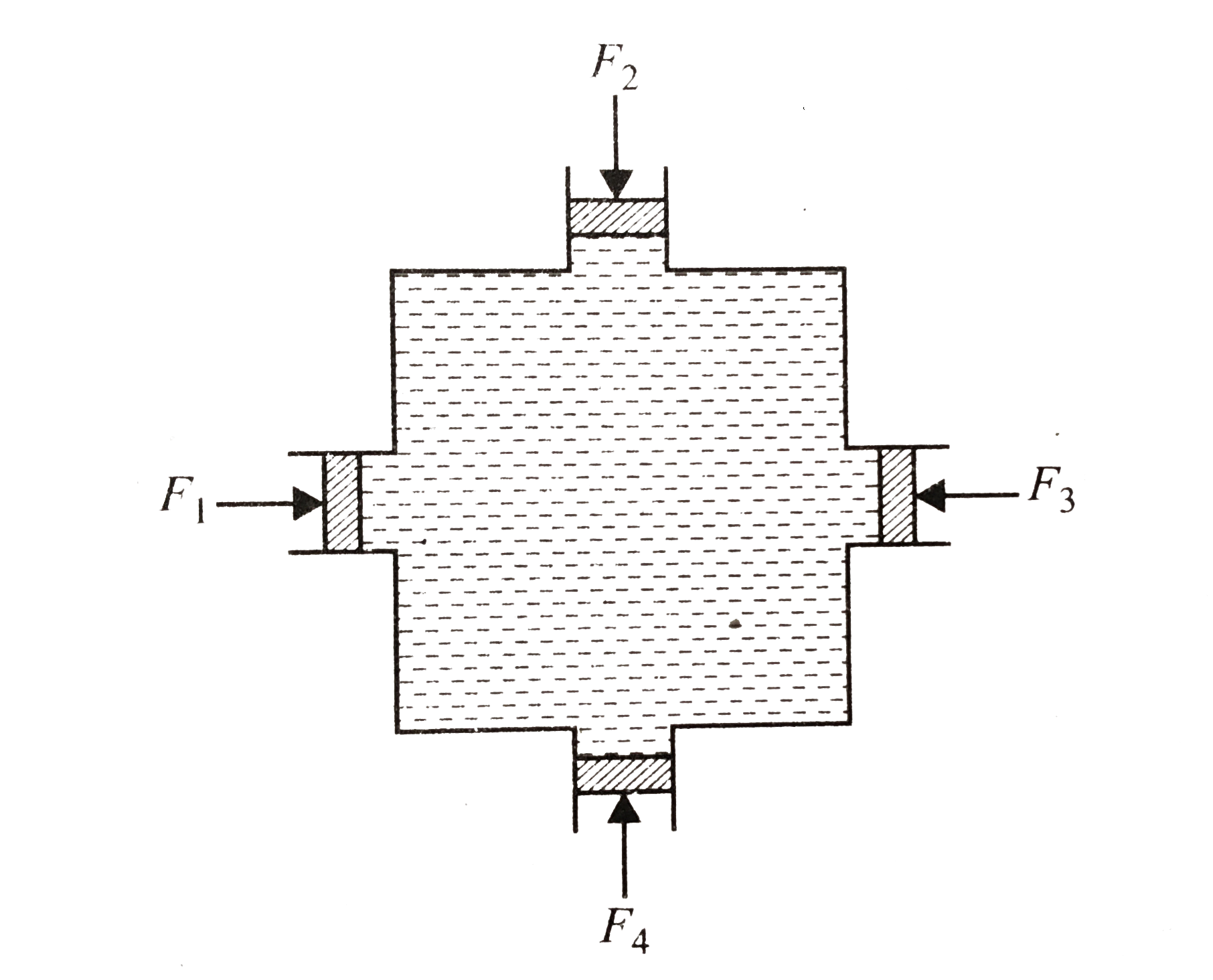
Figure shows water filled in a symmetric...

Figure shows water filled in a symmetrical container. Four pistons of equal area `A` are used at the four openings to keep the water in equilibrium. Now an additional force `F` is applied at each piston. The increase in the pressure at the centre of the container due to this addition is

Promotional Banner

Similar Questions

Explore conceptually related problems

As shown , a piston chamber pf cross section area A is filled with ideal gas. A sealed piston of mass m is right at the middle height of the cylinder at equilibrium. The friction force between the chamber wall and the piston can be ignored . The mass of the rest of the chamber is M .The atmosphere pressure is P_(0) . Now slowly pull the piston upwards , find the maximum value of M such that the chamber can be lifted off the ground. The temperature remains unchanged.

As shown , a piston chamber pf cross section area A is filled with ideal gas. A sealed piston of mass m is right at the middle height of the cylinder at equilibrium. The friction force between the chamber wall and the piston can be ignored . The mass of the rest of the chamber is M .The atmosphere pressure is P_(0) . Now slowly pull the piston upwards , find the maximum value of M such that the chamber can be lifted off the ground. The temperature remains unchanged.

As shown , a piston chamber pf cross section area A is filled with ideal gas. A sealed piston of mass m is right at the middle height of the cylinder at equilibrium. The friction force between the chamber wall and the piston can be ignored . The mass of the rest of the chamber is M .The atmosphere pressure is P_(0) . Now slowly pull the piston upwards , find the maximum value of M such that the chamber can be lifted off the ground. The temperature remains unchanged.

A buoy is held inside water contained in a vessel by tying it with a thread to the base of the vessel. Name the three forces that keep the buoy in equilibrium and state the direction in which each force acts.

When pressure is applied through a piston at the top of a closed tube containing water, the pressure is transmitted to

A gardener is watering plants at the rate 0.litre//sec using a pipe of cross-sectional area 1cm^(2) What additional force he has to exert if he desires to increase the rate of watering two times ? .

A cylindrical container of height 3L and cross sectional area A is fitted with a smooth movable piston of negligible weight. It contains an ideal diatomic gas. Under normal atmospheric pressure P_(0) the piston stays in equilibrium at a height L above the base of the container. The gas chamber is provided with a heater and a copper coil through which a cold liquid can be circulated to extract heat from the gas. Volume occupied by the heater and the liquid coil is negligible. Following set of operations are performed to take the gas through a cyclic process. (1) Heater is switched on. At the same time a tap above the cylinder is opened. Water fills slowly in the container above the piston and it is observed that the piston does not move. Water is allowed to fill the container so that the height of water column becomes L. Now the tap is closed. (2) The heater is kept on and the piston slowly moves up. Heater is switched off at the time water is at brink of overflowing. (3) Now the cold liquid is allowed to pass through the coil. The liquid extracts heat from the gas. Water is removed from the container so as to keep the position of piston fixed. Entire water is removed and the gas is brought back to atmospheric pressure. (4) The circulation of cold liquid is continued and the piston slowly falls down to the original height L above the base of the container. Circulation of liquid is stopped. Assume that the container is made of adiabatic wall and density of water is rho . Force on piston due to impact of falling water may be neglected. (a) Draw the entire cycle on a P–V graph. (b) Find the amount of heat supplied by the heater and the amount of heat extracted by the cold liquid from the gas during the complete cycle.