

Home
Class 11
PHYSICS
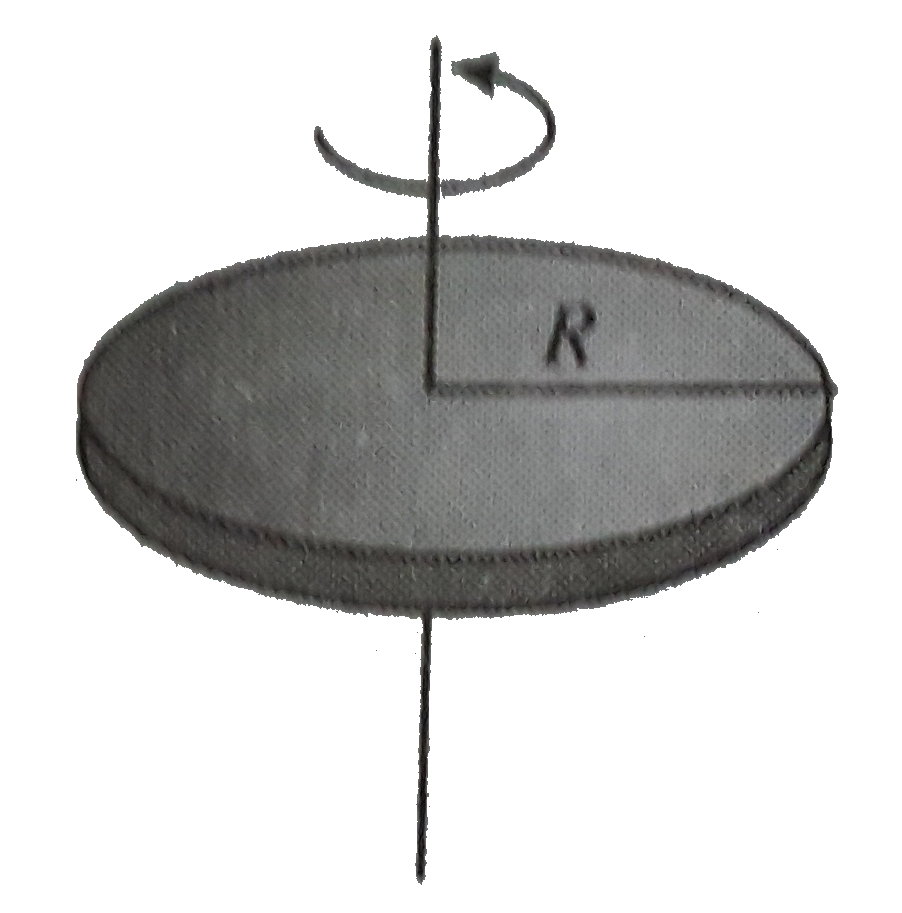
A disc of radius R rotates from rest abo...

A disc of radius R rotates from rest about a vertical axis with a constant angular acceleration such that a coin placed with a tangenitial between a as shown in figure If the coefficient of static friction between the coin and disc is `mu_(s)` .Find the velocity of the before it start sliding relative as the disc

Promotional Banner

Similar Questions

Explore conceptually related problems

A small coin of mass 40 g is placed on the horizontal surface of a rotating disc. The disc starts from rest and is given a constant angular acceleration alpha="2 rad s"^(-2) . The coefficient of static friction between the coin and the disc is mu_(s)=3//4 and the coefficient of kinetic friction is mu_(k)=0.5. The coin is placed at a distance r=1m from the centre of the disc. The magnitude of the resultant force on the coin exerted by the disc just before it starts slipping on the disc is?

A small coin of mass 40 g is placed on the horizontal surface of a rotating disc. The disc starts from rest and is given a constant angular acceleration alpha="2 rad s"^(-2) . The coefficient of static friction between the coin and the disc is mu_(s)=3//4 and the coefficient of kinetic friction is mu_(k)=0.5. The coin is placed at a distance r=1m from the centre of the disc. The magnitude of hte resultant force on the coin exerted by the disc just before it starts slipping on the disc is :

A small coin of mass 80g is placed on the horizontal surface of a rotating disc. The disc starts from rest and is given a constant angular acceleration alpha=2rad//s^(2) . The coefficient of static friction between the coin and the disc is mu_(s)=3//4 and cofficient of kinetic friction is mu_(k)=0.5 . The coin is placed at a distance r=1m from the centre of the disc. The magnitude of the resultant force on the coin exerted by the disc just before it starts slipping on the disc is

A small coin of mass 80g is placed on the horizontal surface of a rotating disc. The disc starts from rest and is given a constant angular acceleration alpha=2rad//s^(2) . The coefficient of static friction between the coin and the disc is mu_(s)=3//4 and cofficient of kinetic friction is mu_(k)=0.5 . The coin is placed at a distance r=1m from the centre of the disc. The magnitude of the resultant force on the coin exerted by the disc just before it starts slipping on the disc is

A small coin of mass 80g is placed on the horizontal surface of a rotating disc. The disc starts from rest and is given a constant angular acceleration alpha=2rad//s^(2) . The coefficient of static friction between the coin and the disc is mu_(s)=3//4 and cofficient of kinetic friction is mu_(k)=0.5 . The coin is placed at a distance r=1m from the centre of the disc. The magnitude of the resultant force on the coin exerted by the disc just before it starts slipping on the disc is

A coin just remains on a disc rotating at 120 r.p.m. when kept at the distance of 1.5 cm from the axis of rotation. Find the coefficient of friction between the coin and the disc.

A disc of radius R=2m starts rotating wth constant angular acceleration alpha=(2rad)//s^(2) . A block of mass m=2kg is kept at a distance (R)/(2) from the centre of disc. The coeffiecient of friction between disc and block is mu_(s)=0.4,mu_(k)=0.3 . Acceleration of block when it just slips w.r.t. ground and w.r.t. disc are respectively - ( g=10ms^(-2) )

A disc of radius R=2m starts rotating wth constant angular acceleration alpha=(2rad//s^(2)) . A block of mass m=2kg is kept at a distance (R)/(2) from the centre of disc. The coeffiecient of friction between disc and block is mu_(s)=0.4,mu_(k)=0.3 . Acceleration of block when it just slips w.r.t. ground and w.r.t. disc are respectively - ( g=10ms^(-2) )

A disc of radius R=2m starts rotating wth constant angular acceleration alpha=(2rad)//s^(2) . A block of mass m=2kg is kept at a distance (R)/(2) from the centre of disc. The coeffiecient of friction between disc and block is mu_(s)=0.4,mu_(k)=0.3 . Acceleration of block when it just slips w.r.t. ground and w.r.t. disc are respectively - ( g=10ms^(-2) )