

Home
Class 11
PHYSICS
A plank of mass M and length L is placed...

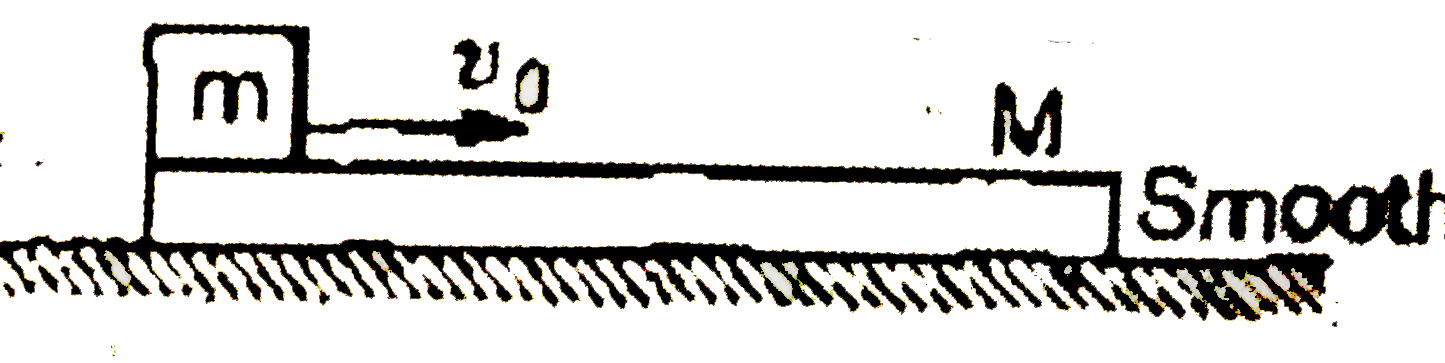
A plank of mass M and length L is placed at rest on a smooth horizontal surface A small block of mass m is projected wii:h a velocity `v_(0)` as shown in the Fig. 3.31 (a), The coefficient of friction between the block and the plank is `mu`, plank is very long so that block eventually comes to rest on it.
(i) Find the work done by the ftjctioh force on the block during the period it slides on the plank. Is the Work positive or negative ?'
(ii) Calculate the work done on the plank during the same period. Is the work positive or negative?
(iii) Also, determine the net work done by friction. Is it positive or negative ?

Promotional Banner

Similar Questions

Explore conceptually related problems

A plank of mass M and length L is placed at rest on a smooth horizontal surface. A small block of mass m is projected with a velocity v_0 from the left end of it as shown in figure. The coefficient of friction between the block and the plank is m, and its value is such that the block becomes stationary with respect to the plank before it reaches the other end. a. Find the time and common velocity when relative sliding between the block and the plank stops. b. Find the work done by the friction force on the block during the period it slides on the plank. Is the work positive or negative? c. Calculate the work done on the plank during the same period. Is the work positive or negative? d. Also, determine the net work done by friction, Is it positive or negative?

A long block A is at rest on a smooth horizontal surface. A small block B whose mass is half of A, is placed on A at one end projected along A with some velocity v. The coefficient of friction between the block is mu

A long block A is at rest on a smooth horizontal surface. A small block B whose mass is half of mass of A is placed on A at one end and is given an initial velocity u as shown in figure. The coefficient of friction between the blocks is mu .

A long block A is at rest on a smooth horizontal surface. A small block B whose mass is half of mass of A is placed on A at one end and is given an initial velocity u as shown in figure. The coefficient of friction between the blocks is mu .

A long block A is at rest on a smooth horizontal surface. A small block B, whose mass is half of A, is placed on A at one end and projected along A with some velocity u. The coefficient of friction between the blocks is mu :

A long block A is at rest on a smooth horizontal surface. A small block B, whose mass is half of A, is placed on A at one end and projected along A with some velocity u. The coefficient of friction between the blocks is mu :

A long plank of mass M is initially at rest on a frictionless surface. A small block with mass m and initial speed u_(0) slides on top of the larger plank. The coefficient of friction between the block and plank is mu Net work done by friction if the top block falls off the plank after sliding over its length L is

A long plank of mass M is initially at rest on a frictionless surface. A small block with mass m and initial speed u_(0) slides on top of the larger plank. The coefficient of friction between the block and plank is mu Net work done by friction if the top block falls off the plank after sliding over its length L is

The block of mass m is kept on plank of mass M. The block is given velocity V_(0) as shown. The coefficient of friction between the block of mass m and plank of mass M is mu and its value is such that block becomes stationary with respect to plank before it reaches the other end. Then: