

Home
Class 12
CHEMISTRY
The combustion of 0.2 mol of liquid carb...

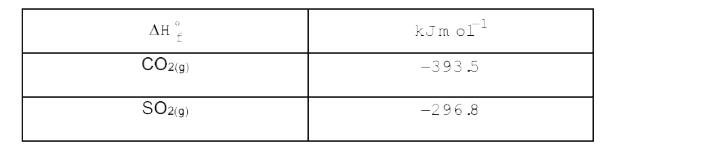
The combustion of 0.2 mol of liquid carbon disulphide `CS_2` to give `CO_2(g) and SO_2(g)` releases 215 kJ of heat. What is `Delta H_(f)^(@) "for" CS_(2(l)) "in" kJmol^(-1)` :

Promotional Banner

Similar Questions

Explore conceptually related problems

The combustion of 0.200 mol of liquid carbon disulphide, CS_(2) to give CO_(2)(g) and SO_(2)(g) releases 215 KJ of heat . What is DeltaH_(F)^(@) for CS_(2)(l) in Kjxxmol^(-1) ? , {:(DeltaH_(f)^(@),kj.mol^(-1)),(CO_(2)(g),-393.5),(SO_(2)(g),-296.8):}

The enthalpy change for the combustion of N_(2)H_(4)(l) (Hydrazine) is -622.2 kJ mol^(-1) . The products are N_(2)(g) and H_(2)O(l) . If Delta_(f)H^(Theta) for H_(2)O(l) is -285.8 kJ mol^(-1) . The Delta_(f)H^(Theta) for hydrazine is

The enthalpy change for the combustion of N_(2)H_(4)(l) (Hydrazine) is -622.2 kJ mol^(-1) . The products are N_(2)(g) and H_(2)O(l) . If Delta_(f)H^(Theta) for H_(2)O(l) is -285.8 kJ mol^(-1) . The Delta_(f)H^(Theta) for hydrazine is

The equations representing the combustion of carbon and carbon monoxide are : C(s) + O_(2)(g) to CO_(2)(g) DeltaH = -394 (kJ)/(mol) CO(s) + 1/2 O_(2)(g) to CO_(2)(g) DeltaH = -284.5 (kJ)/(mol) the heat of formation of 1 mol of CO(g) is :

The equations representing the combustion of carbon and carbon monoxide are: 'C(s)+O_2(g) rarr CO_2(g) Delta H=394 kJ / mol' 'CO(s)+1/2 O_2(g) rarr CO_2(g) Delta H=-284.5 kJ / mol' the heat of formation of 1 mol of 'CO(g)' is

The combustion of 1 mol of benzene takes place at 298 K and 1 atm . After combustion, CO_(2)(g) and H_(2)O(l) are produced and 3267.0 kJ of heat is librated. Calculate the standard entalpy of formation, Delta_(f)H^(Θ) of benzene Given: Delta_(f)H^(Θ)CO_(2)(g) = -393.5 kJ mol^(-1) Delta_(f)H^(Θ)H_(2)O(l) = -285.83 kJ mol^(-1) .

The combustion of 1 mol of benzene takes place at 298 K and 1 atm . After combustion, CO_(2)(g) and H_(2)O(l) are produced and 3267.0 kJ of heat is librated. Calculate the standard entalpy of formation, Delta_(f)H^(Θ) of benzene Given: Delta_(f)H^(Θ)CO_(2)(g) = -393.5 kJ mol^(-1) Delta_(f)H^(Θ)H_(2)O(l) = -285.83 kJ mol^(-1) .

When 12.0g of carbon (graphite)reacted with oxygen to form CO and CO_(2) at 25^(@)C and constant pressure, 252 kJ of heat was released and no carbon remained. If Delta H_(f)^(0)(CO,g)= -110.5 kJ mol^(-1) and Delta H_(f)^(0)(CO_(2),g)= -393.5 kJ mol^(-1) ,calculate the mass of oxygen consumed.

When 12.0g of carbon (graphite)reacted with oxygen to form CO and CO_(2) at 25^(@)C and constant pressure, 252 kJ of heat was released and no carbon remained. If Delta H_(f)^(0)(CO,g)= -110.5 kJ mol^(-1) and Delta H_(f)^(0)(CO_(2),g)= -393.5 kJ mol^(-1) ,calculate the mass of oxygen consumed.