

Home
Class 12
CHEMISTRY
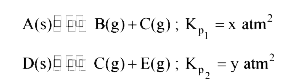
Two solids dissociates as follows . ...

Two solids dissociates as follows
.
The total pressure when both the solids dissociate simultaneously is :

Promotional Banner

Similar Questions

Explore conceptually related problems

Two solids dissociates as follows A(s) rarr B(g) + C(g), K_(P_(1)) = x atm^(2) D(s) rarr C(g) + E(g), K_(P_(2)) = y atm^(2) The total pressure when both the solids dissociate simultaneously is :

Two solids dissociates as follows A(s) rarr B(g) + C(g), K_(P_(1)) = x atm^(2) D(s) rarr C(g) + E(g), K_(P_(2)) = y atm^(2) The total pressure when both the solids dissociate simultaneously is :

A(s)hArrH_(2)S(g)+B(g) At eq., pressure = 18 atm C(s)hArrH_(2)S(g)+D(g) At eq., pressure = 36 atm Calculation total pressure at new equilibrium when both the solids are heated simultaneously

The dissociation equilibrium pressure of NH_(4)HS_((s)) is 60 cm at 27^(@)C . The total pressure at equilibrium, when the NH_(4)HS is dissociated in pressence of 45 cm of NH_(3) is :

Solid NH_(4)HS(s) (ammonium hydrogen sulphate) dissociates to give NH_(3)(g) and H_(2)S(g) and is allowed to attain equilibrium at 100^(@)C . If the value of K_(p) for its dissociation is found to be 0.34 , find the total pressure at equilibrium at 100^(@)C . If the value of K_(p) for its dissociation is found to be 0.34 , find the total pressure at equilibrium and partical pressure of each component.

Solid NH_(4)HS(s) (ammonium hydrogen sulphate) dissociates to give NH_(3)(g) and H_(2)S(g) and is allowed to attain equilibrium at 100^(@)C . If the value of K_(p) for its dissociation is found to be 0.34 , find the total pressure at equilibrium at 100^(@)C . If the value of K_(p) for its dissociation is found to be 0.34 , find the total pressure at equilibrium and partial pressure of each component.

The pressure at equilibrium over solid A is 50 atm and over solid D is 68 atm if both solid A and D are heated simultaneously .Find: relative number of moles of A ′and B in the vapour phase over a mixture of the solids A and B.

Two solid compounds A and B dissociate into gaseous products at 20^(@)C as a. A(s) hArr A'(s)+H_(2)S(g) b. B(s) hArr B'(g)+H_(2)S(g) At 20^(@)C pressure over excess solid A is 50 mm and that over excess solid B is 68 mm. Find: a. The dissociation constant of A and B b. Relative number of moles of A' and B' in the vapour phase over a mixture of the solids A and B. c. Show that the total pressure of gas over the solid mixture would be 84.4 mm.

Two solid compounds A and B dissociate into gaseous products at 20^(@)C as a. A(s) hArr A'(s)+H_(2)S(g) b. B(s) hArr B'(g)+H_(2)S(g) At 20^(@)C pressure over excess solid A is 50 mm and that over excess solid B is 68 mm. Find: a. The dissociation constant of A and B b. Relative number of moles of A' and B' in the vapour phase over a mixture of the solids A and B. c. Show that the total pressure of gas over the solid mixture would be 84.4 mm.